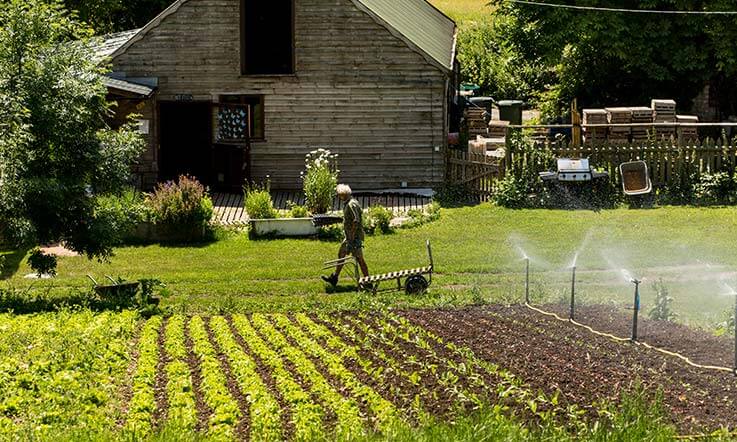

On the tenth of June Julia Cooper and members of the English Organic Forum met with Defra Minister Dame Angela Eagle DBE MP and her team at Riverford Organic Farmers Sacrewell Lodge Farm near Peterborough. The Minister is gathering information to feed into an Organic Action Plan for England which is being developed collaboratively with the industry and Defra. This follows on from a letter written to the Minister in January urging her to include an Organic Action Plan for England within the Government’s farming roadmap.

It was a very positive meeting in which the Minister highlighted the ‘nature emergency’ and talked about organic as an obvious ‘holistic’ solution. Much of the discussion was around public procurement and the challenges, as well as the role of organic in addressing issues around poverty and poor nutrition.

In a government re-shuffle announced on Friday 12th June Dame Angela Eagle DBE MP has moved to become Minister of State (Security Minister) jointly in the Home Office and the Cabinet Office. Stephen Morgan MP has been appointed as Minister of State in the Department for Environment, Food, and Rural Affairs in her place. We are hopeful that there will be continuity and momentum towards an Organic Action Plan will continue with the new minister.
The Organic Research Centre (ORC) has been one of the key organisations involved in the development, evaluation, and promotion of Organic Action Plans (OAPs) in Europe for more than two decades.
Organic Action Plans are strategic frameworks used by governments, regions, and stakeholders to support the development of organic farming and food systems. They typically combine policy measures, market development, research, training, advisory services, and public procurement initiatives to grow the organic sector.
Building on Nic Lampkin’s work as part of the EU project “ORGAP – European Action Plan for organic food and farming – Development of criteria and evaluation procedures for the evaluation of the EU Action Plan for Organic Agriculture” which produced A resource manual for the organic food and farming sector in 2008 while at Aberystwyth, ORC (Nic Lampkin and Susanne Padel) co-authored Organic Action Plans: a guide for stakeholders in 2015. This was a major review for IFOAM Organics Europe examining organic action plans across 32 European countries. The study found that Organic Action Plans had become an increasingly important policy instrument since the mid-1990s and identified examples of good practice as well as common weaknesses, such as lack of budgets, targets, and continuity between planning cycles. ORC concluded that action plans are most effective when used as strategic tools to mobilise resources and coordinate sector development rather than as ends in themselves.
In 2018, ORC worked with FiBL and IFOAM Organics Europe to produce the second edition of the Organic Action Plans: Development, Implementation and Evaluation manual which drew on more than 20 years of European experience and provided detailed guidance on:
Through the Interreg Europe SME Organics project (2016–2020), ORC helped eight European regions develop and implement regional organic action plans. ORC’s role included advising regional governments and stakeholders, sharing best practices, and co-authoring the updated Organic Action Plan manual (See article in ORC Bulletin No. 124, Spring 2018).
Despite all this work there has never been an enduring Organic Action Plan for England. In 2002 in the middle of an organic boom Defra did publish an Action plan to develop organic food and farming in England, but it was not maintained as a continuously updated national strategy.
We have been here before. In 2017 an ‘Organic Roundtable‘ was formed by Defra and the English Organic Forum, with discussions on Actions for the English Organic Action Plan continuing at The UK Organic Congress in 2018. Despite these efforts a formal government-adopted Organic Action Plan has not yet materialised.
Meanwhile, ealier this year, Scotland Food & Drink, alongside the Scottish Government and a partnership of organisations, including SAOS and Soil Association Scotland,published an innovative new Scottish Organic Action Plan 2026-2029 designed to grow the country’s thriving organic sector.
In the European Union the OrganicTargets4EU Horizon Europe project has released comprehensive policy recommendations to support the EU’s ambition of expanding organic farming and organic aquaculture across Europe. See: Advancing Europe’s Organic Transition: Policy Pathways to 2030 and Beyond.
See also: Farmers Guardian : Farming Minister discusses English Organic Action Plan at Riverford farm