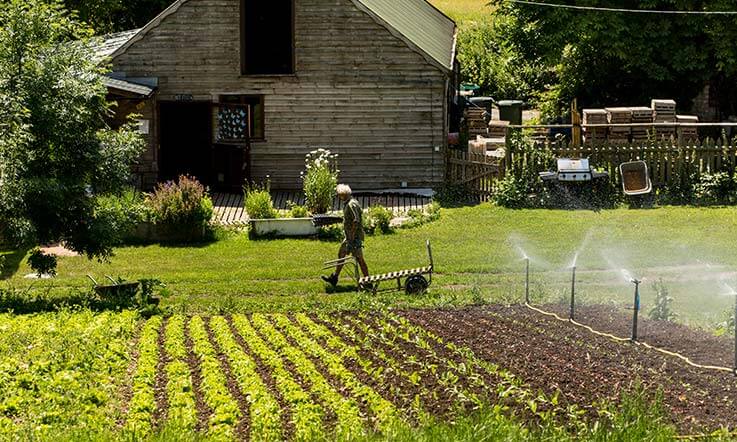

There’s nothing like a room full of farmers and agricultural advisors to take a scientist down a peg or two! At our industry workshops on 10th February we invited farmers and advisors who routinely assess soil health (see Figure 1) to come along and give us feedback on our current shortlist of indicators….and they certainly didn’t hesitate to tell us what they thought! Julia Cooper reports.

The Early Indicators of Soil Health (EISH) project builds on the AHDB’s existing Soil Health Scorecard that uses Visual Evaluation of Soil Structure (VESS), pH, extractable nutrients (phosphorus, potassium and magnesium), numbers of earthworms and soil organic matter to assess changes in soil health every 3-5 years. In parallel with the development of the SHSc, various commercial laboratories have been offering soil health testing using chemical and biological tests, and keen practitioners have been getting trained in DIY soil biology assessments using microscopes. These developments prompted the AHDB to fund this project which aims to update guidance on soil health testing with a particular focus on EISH.
Early indicators of soil health are used to track impacts of recent changes in soil management; think of something that could be measured in the same field in the same season every year and provide a reliable indication of the direction of change in soil health. EISH need to have a direct link with key soil functions like nutrient supply, water cycle regulation, climate mitigation, soil biodiversity and ultimately crop yield and resilience. Identifying a good EISH is challenging. It needs to sit in a sweet spot for sensitivity – reactive to recent changes in management, but not so sensitive that recent weather events or changes in crop species will affect the result. This rules out many biological indicators like in situ respiration, enzyme assays, microbial fingerprinting methods or microscopy, which can be highly variable throughout the season and from year to year, depending on weather conditions, crop etc.
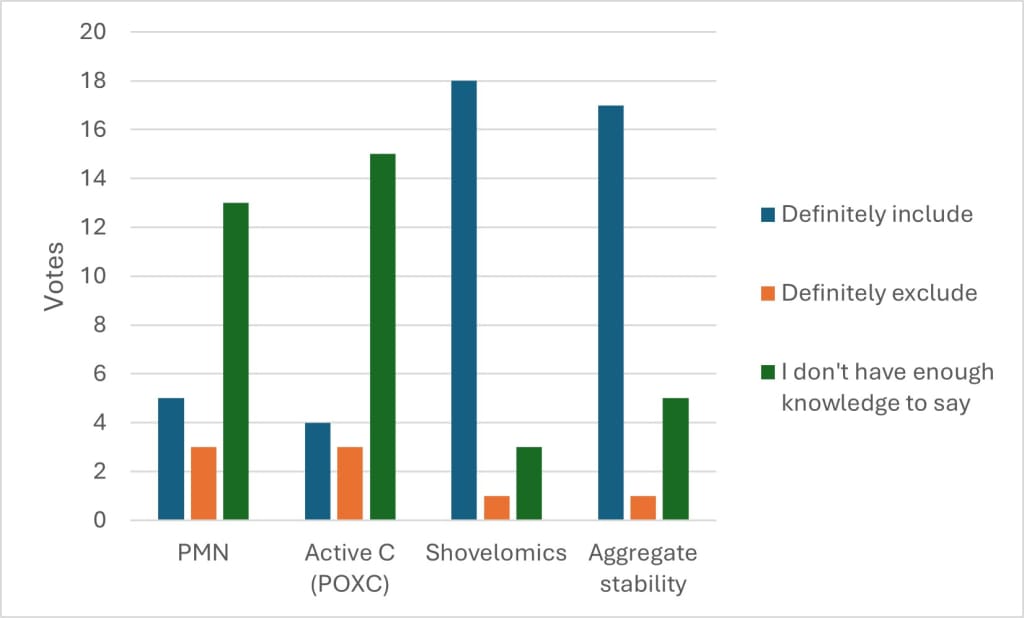
At our industry workshop we pitched our shortlist of four EISH selected following discussions with our Expert Advisory Group and review of evidence. These were: crop rooting or “shovelomics”, aggregate stability, potentially mineralizable nitrogen and permanganate oxidisable carbon. Menti surveys, breakout rooms, whiteboards and the chat function were all used to compile participant views and comments. A few messages came through loud and clear!
First, we had presented aggregate stability as a laboratory test that was laborious and not currently on offer from any commercial laboratory in the UK. But participants were disappointed we had not considered field measures of aggregate stability, with one commenting “slake tests and water infiltration tests are more relevant for farmers. Personally I’d leave the lab tests for scientific research purposes.” Message received loud and clear! In the final stage of the project we will be compiling guidance on DIY measures of aggregate stability like the Slakes app.
Another surprise was the strong reaction against using potentially mineralisable nitrogen as an indicator. This was largely due to a lack of understanding about what it indicates with various participants commenting that it is “complicated for farmers to grasp its relevance….” And “this would need some good PR/communication to really explain how to use it and how to read it…”.
Permanganate oxidisable carbon (more commonly knows as POXC) sparked discussion with some participants questioning if it would tell us more than a simple SOM test.
At the end of the workshops we asked participants to anonymously vote on our top four EISH (Figure 2). Those that could be measured directly by farmers and advisors like shovelomics and aggregate stability (using a slake test) were clear winners, with laboratory tests viewed less favourably. Our next steps will be to develop some guidance on how to implement EISH in the field and complement the existing soil health indicators. Industry input through these workshops has been invaluable in grounding the team in the practicalities of designing and delivering a useful soil health testing programme for the industry. Our final report will be published at the end of March. Watch this space for more information on how to use EISH on the farm to guide soil management decisions.