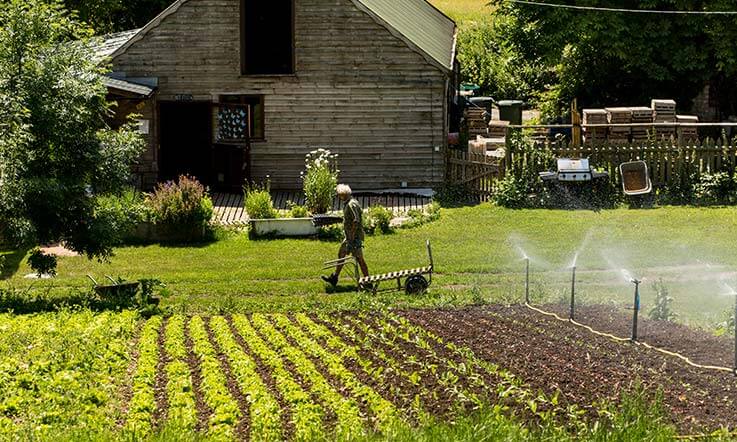

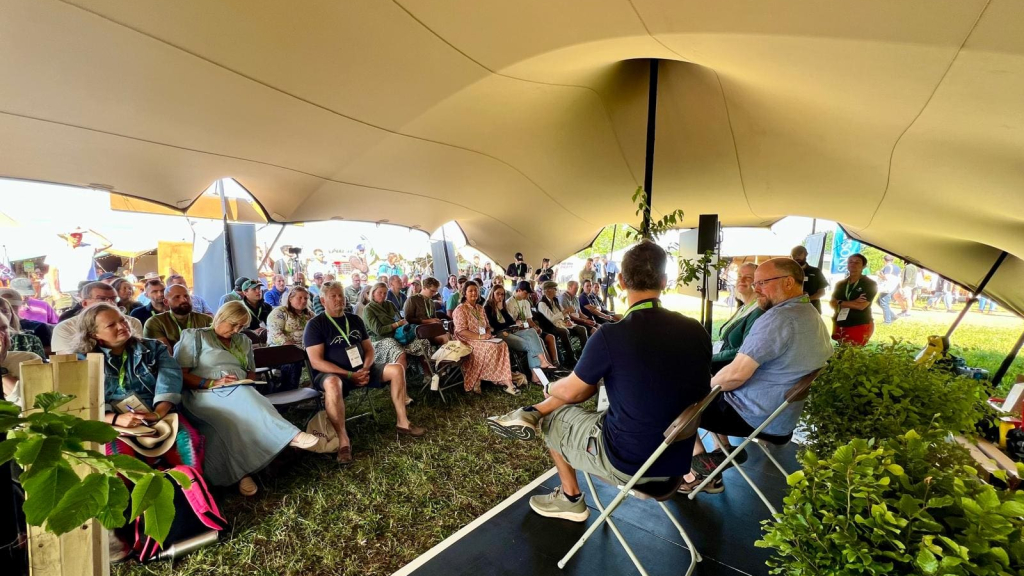
ORC’s Philippa Hall was at the Improving Habitat Connectivity on your Farm session in the Agroforestry tent at Groundswell with Colin Tosh, Tim Coates and Lisa Norton and asks the question: “Are we asking too much of our hedgerows?”
While I waited for the session to start I chatted to people about why they were there. As far as some of the farmers I spoke to were concerned, hedges are the ultimate ecological win-win, but what is the winning formula to get the best return of their investment for their farm? We know they look great, we know they provide shelter, and we’ve been told for years that they act as vital wildlife highways, linking up isolated patches of woodland across our fragmented British landscape.
Tim Coates, a mixed farmer from Chipping Norton opened and chaired the session. Tim has planted a staggering 6.5 kilometers of hedges (around 35,000 trees!) over the last decade – he’s clearly committed; we all want this to work.
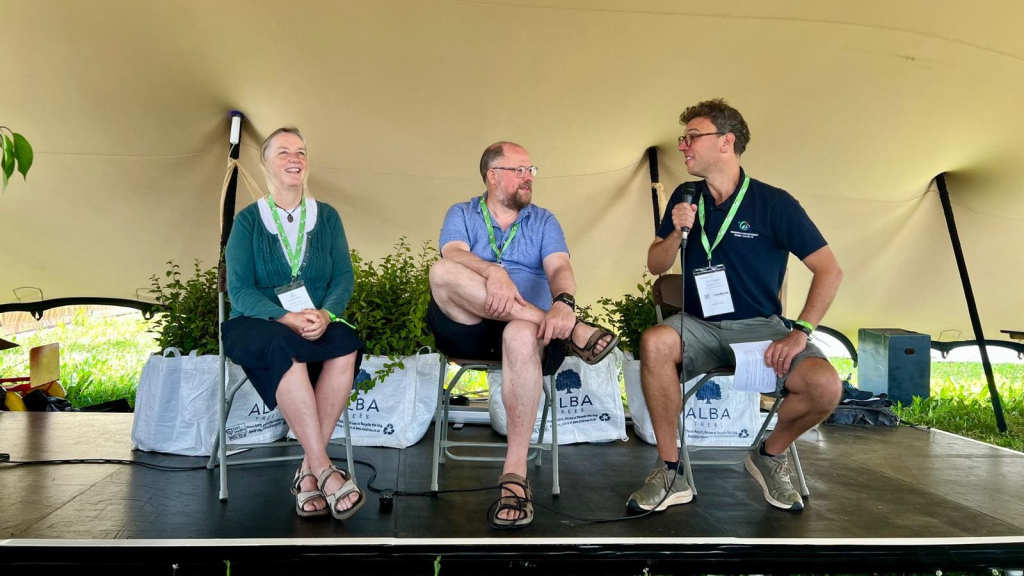
Colin Tosh, senior agroforestry researcher at ORC, laid out the fundamentals of habitat connectivity according to the textbooks. Why do we want these corridors in the first place? There are two key reasons:
It all makes intuitive sense. But then Colin presented a findings from a recent study from ORC funded by The Progressive Farming Trust which has challenged this thinking.
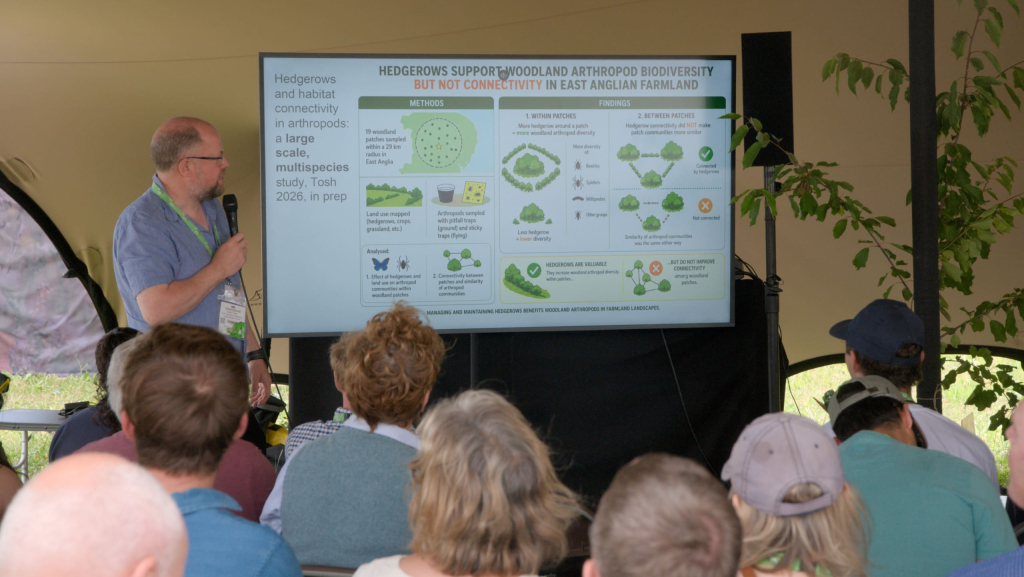
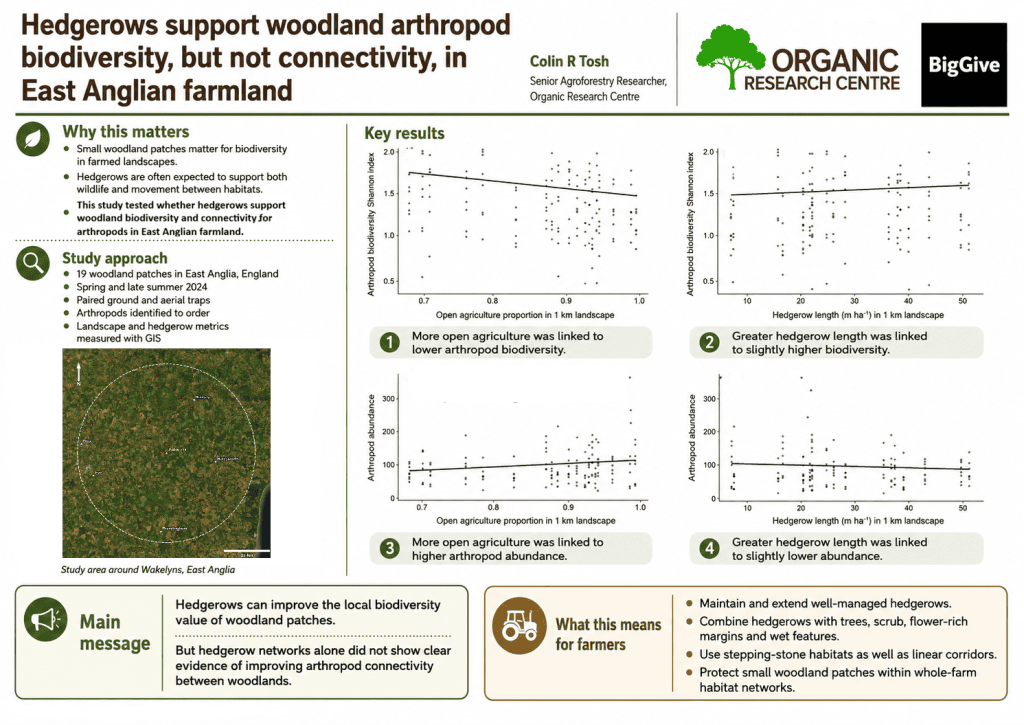
Colin set out in the Importance of Hedgerows as Wildlife Corridors project to prove whether hedgerows actually promote this crucial connectivity. He took insect samples across 19 different woodland patches scattered over a massive quarter of a million hectares in Suffolk. He paired the results from his fieldwork with high-tech LiDAR maps developed by the UK Centre for Ecology and Hydrology (UKCEH), who have been monitoring how our country’s hedges have changed over decades.
Using this data, Colin looked at two things:
The results were a scientific mixed bag.
For the first question, yes. If there is a high density of hedgerows within a 1 to 3-kilometer radius of a woodland, that wood is noticeably more biodiverse. There is a clear influx of arthropods—insects, spiders, millipedes—coming from the hedges into the woods.
But for the second question—the big one about the ‘wildlife highway?’ The results weren’t quite what we expected.
Colin couldn’t find any evidence that patches connected by hedges were more similar than unconnected ones. The insects weren’t moving between distant woodland patches in numbers large enough to detect.
You could see the audience faces of confusion, where internal alarm bells started ringing. Have we been wasting our time planting miles of hedges under the assumption that they are connecting the landscape?
Tim immediately fired the question we were all thinking back at the panel: How does this compare to other research? Are our hedges just not working?
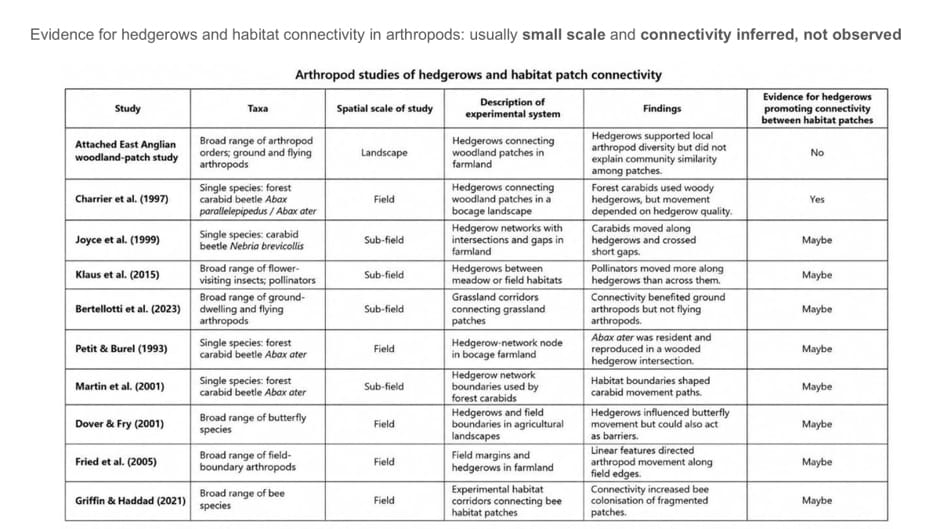
Colin pulled up a table of previous global studies on arthropods to give us some perspective. It turns out, the evidence for insects using hedges as long-distance migratory corridors has always been surprisingly thin. Most studies show that insects will move to a field margin, or trundle along a hedge for a little bit, but few have definitively proven full migration between distant habitat patches.
However, Colin noted that for other species—like forest herbs and birds—the evidence for hedgerows acting as connected corridors is incredibly strong.
So why are the insects stalling out? Colin raised a point that shifted the blame away from the concept of hedges and squarely onto the condition of them.
In the regions studied, like Suffolk and Norfolk, vast stretches of historic hedgerows have been pulled out over the last century. The ones that remain are often fragmented, over-flailed, or neglected. If a highway is full of massive potholes, missing bridges, and dead ends, you can’t blame the cars for not getting to the next city.
It made us look at the whole issue through a different lens. It’s not enough to just plant a line of whips and tick a box. The quality of the hedge matters immensely. A thin, broken line of hawthorn won’t cut it for a delicate woodland spider or a beetles looking for damp, continuous shade.
Tim pressed Colin on how this compared to other research, and Colin went back to slides summarising previous studies on arthropods; it turns out, while we’ve seen insects hang out in field margins or bumble along a hedge for a few meters, almost no studies have actually proven that insects use hedges to migrate from one major habitat patch to another.
However, there is a massive caveat here. It depends entirely on who is using the highway:
So, what’s the fix? Colin didn’t say ”stop planting hedges.” Instead, he argued that if we want to help insects move, a standard hedge isn’t enough. We need a “suite of connective structures.” Think bigger, messier, and more complex: You need structural stepping stones – occasional mature trees breaking out of the hedge line, damp ditches, and parallel wildflower strips.
This is where Tim’s perspective as a farmer brought the science back down to earth. For Tim, planting hedges and woods isn’t just an abstract ecological exercise; it’s a resilience play.
Even if the bugs aren’t migrating miles down his hedge lines, those habitats support the core business of farming. Well-managed, thick hedges provide shade and shelter for his sheep, acting as natural climate control. In his arable fields, those biodiverse hedges house the beneficial predators that fuel his Integrated Pest Management (IPM) strategy, keeping crop pests in check right at the field edge.
So, the hedges are working—they just might be functioning as local strongholds and buffet stations rather than trans-continental railways.
The session wrapped up with some points from Lisa Norton, agroecologist and senior scientist from UKCEH, and a reality check on the state of the UK’s hedges, drawing on data from UKCEH and Hedgelink.
If a hedge is going to function, condition is everything. Hedgelink highlight the standardised criteria for a hedge to be considered in ‘good condition’:
The good news? A recent UKCEH countrywide survey comparing hedges from 2009 to 2021 found that our hedges are getting slightly taller on average (up about 20 cm). The bad news? Too many hedges are still completely unmanaged, left to grow out into thin, leggy lines of trees that lose their dense, protective base structure.
What have we learnt ?
The audience left the session realising that we might be asking too much of poor-quality hedges while neglecting the massive value they do provide right on their doorstep. Even if they aren’t acting as effective interstate highways for every single insect species yet, Colin’s study proves they are still vital local powerhouses of biodiversity that enrich the fields and woods directly around them.
If we want them to do the heavy lifting of reconnecting our fractured countryside, we have to treat them like infrastructure. We need to manage them properly, let them grow thick, keep them continuous, and value them as living habitats in their own right—not just property boundaries.
For more information on the hedgerow project and updates on the study once it is published, please sign up to our e-bulletin.