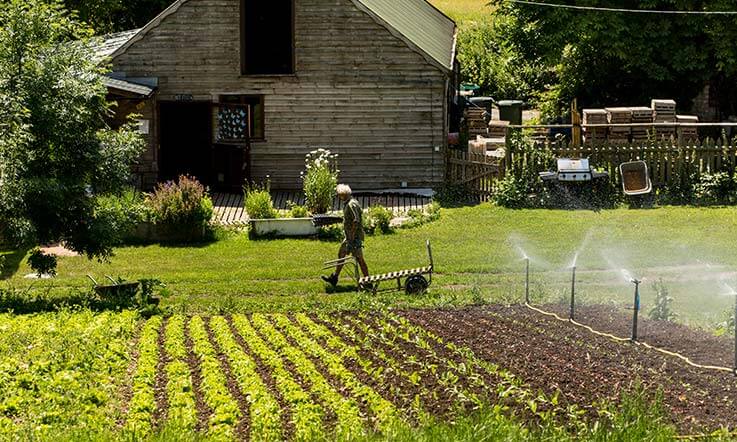

We welcome the indication that organic conversion and maintenance payments are to continue under SFI in England in 2026. Organic farmers operate within a regulatory framework that requires higher management input, more diverse rotations, and careful stewardship of soil, livestock and biodiversity. These systems often involve greater labour and compliance costs, particularly during the conversion period when price premiums are not yet fully available.

Our work has consistently shown over the years that organic farming delivers enhanced public goods — including improved soil structure and fertility, reduced synthetic input use, increased biodiversity, and benefits for water quality and climate resilience. Continued support recognises that these outcomes carry value beyond the farm gate and that farmers should be fairly rewarded for delivering them.
This week at the National Farmers Union (NFU) conference, the Secretary of State Emma Reynolds shared more detail on how the government will deliver its vision for agriculture in England (Improving productivity, economic growth and innovation, building stronger partnerships across the supply chain and safeguarding food security).
On the Defra blog you will find updates on:
Defra stated that “We are keeping 11 specialist organic actions, even though currently they have relatively low uptake. This includes 5 organic conversion actions to support farmers in the process of conversion, and 6 organic management actions. Organic farmers can also apply for conventional SFI actions.” The inclusion of both conversion and maintenance payments is particularly welcome.
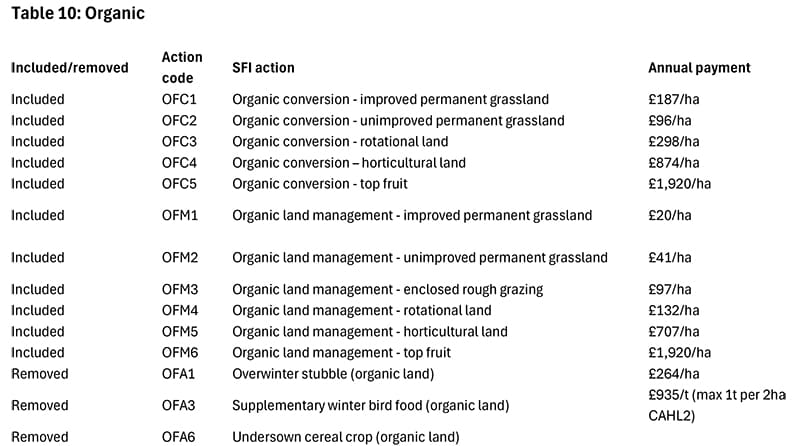
Defra stated that they are removing OFA1, OFA3 and OFA6 because they have very low uptake, and alternatives are available (AHW6: Basic overwinter stubble, AHW2: Supplementary winter bird food, and CIPM3: Companion crops).
See: Organic sector welcomes sustained support through SFI 2026
We are pleased that the agroforestry options remain under the SFI despite “low/moderate uptake” as they “have potential to make a moderate/high contribution to our environmental targets.”
The new SFI 2026 is scheduled to open in two ‘windows’ – one in June for ‘small farmers’ and first-time applicants, and a more general application window in September.
Agreements will be restricted to one per farm, with a maximum value of £100,000 per year. The duration will be reduced from five years to three, and the £50 per hectare management payment will be eliminated, with those funds reallocated to support environmental measures. John Pawsey commented on X: “Very disappointed to see that #SFI26 has a cap at £100k. I think it’s divisive. A cap of an amount per hectare would have been fairer for farmers and for nature.”
Payment rates will increase for moorland grazing and shepherding options, while being reduced for herbal leys, winter bird food, and legume fallow – the three most widely adopted SFI actions under previous schemes.
The number of actions eligible for funding has been reduced from 102 to 71.
To be eligible for SFI26 (for both Windows 1 and 2) farmers should have at least 3 hectares (ha) of agricultural land. Steven Jacobs, OGA coordinator said: “A 3 ha minimum will prohibit so many growers who are delivering already and will prevent smaller scale horticulture start-ups. Small to medium-scale organic fruit & vegetable growers are delivering huge benefits for the families buying their produce. Defra claimed that among the reasons for changing the Sustainable Farming Incentive was on the evidence that the 4% highest-paid farm businesses under the scheme took 25% of SFI money. But whatever Defra’s reasoning for limiting size and scope of those eligible now, they may be going directly against the stated intent of the Sustainable Farming Incentive to benefit the environment while producing good quality food.”
‘Clear budgets will be set for each window’ suggesting measures to prevent the first window from exhausting the entire SFI budget.