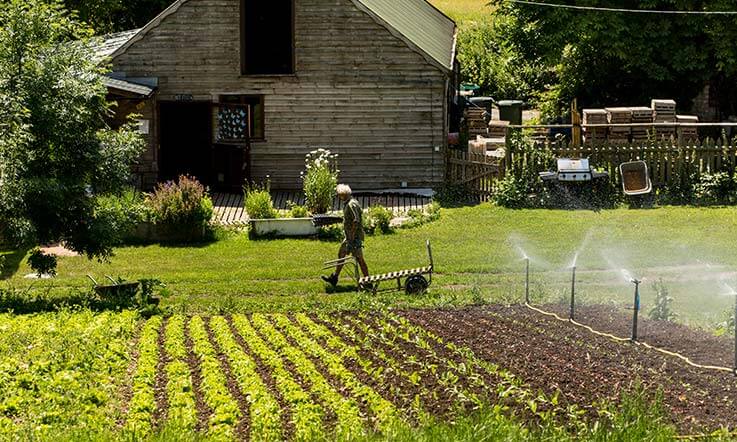

On 15th October, Glastonbury Nut Farm hosted growers, researchers, advisers and anyone interested in the future of British nut production for a demonstration of a piece of agricultural machinery not typically found in the UK — the AMB Rousset X15 nut harvester.
The event was an opportunity to share early experiences from an Innovate UK ADOPT-funded trial, exploring whether mechanised harvesting could help overcome one of the practical barriers to producing nuts commercially in the UK.
But the day offered much more than a machinery demonstration. From the challenges of establishing productive orchards to ambitious plans for shared processing facilities and grower networks, visitors gained an insight into Glastonbury Nut Farm’s wider vision for British nut production.
The day included practical demonstrations, a farm tour, presentation and space for sharing experiences. What emerged was not only a picture of the challenges facing this developing sector, but also a real sense of enthusiasm for finding solutions together.
Harvesting is a major challenge for commercial nut growers. Collecting nuts by hand is slow and labour-intensive. At the same time, most specialist harvesting machinery has been developed for very different growing conditions overseas.
Glastonbury Nut Farm has spent several years investigating how these technologies might be adapted for British orchards. As discussed in our earlier article following Groundswell, Glastonbury Nut Farm farmer Andrew and technical director Laurie assessed a range of European machines before selecting the French-manufactured AMB Rousset X15. Its self-propelled design and substantial sweeping system appeared particularly well suited to collecting fallen nuts from grass-covered orchards.
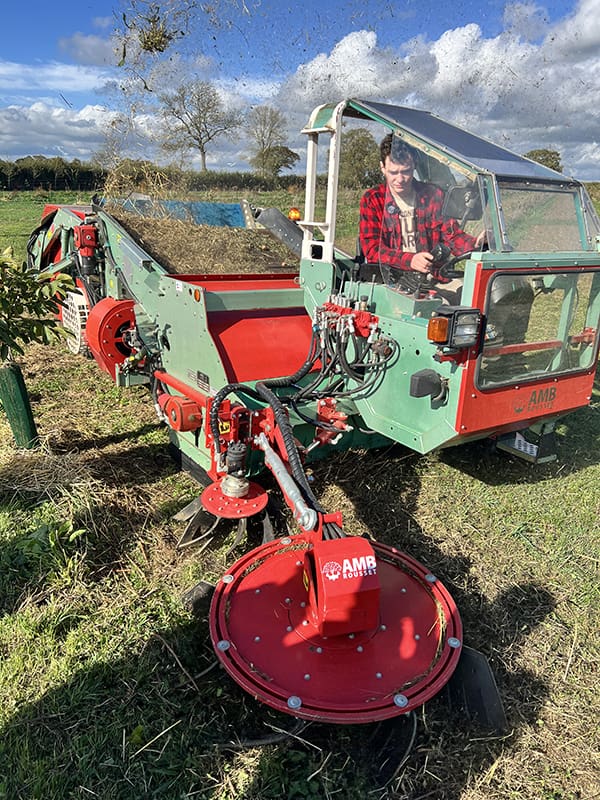
The ADOPT trial is putting the machine through its paces in UK conditions, examining how effectively it can collect nuts and how harvesting speed is affected by different terrain, orchard layouts and ground vegetation. The demonstration day offered an opportunity to share some of the team’s early experiences.
The trial has already highlighted several practical challenges. On sloping ground, nuts tended to roll backwards along the machine’s conveyor when travelling uphill. Changing the harvesting route to run diagonally across the slope helped overcome this problem. Grass accumulating around the machine’s cooling system also caused interruptions, while low-hanging branches made manoeuvring between trees more difficult.
These may seem like relatively small issues, but they offer valuable lessons for growers considering mechanisation. The effectiveness of a harvester depends not only on the machine itself, but also on how the orchard is designed and managed. Tree spacing, pruning, ground vegetation and terrain can all affect harvesting efficiency.
Despite the challenges, the early experience points to considerable potential. Mechanised collection could allow growers to cover much larger areas in a shorter time than manual harvesting. It also makes repeated passes more practical, allowing nuts to be collected as they fall throughout the season and potentially reducing losses to squirrels and other wildlife. This could help growers collect their crops within the available weather window and make harvesting at a commercial scale more achievable. The full results, including the implications for labour requirements and commercial viability, will be shared once the project is complete at the end of the year.
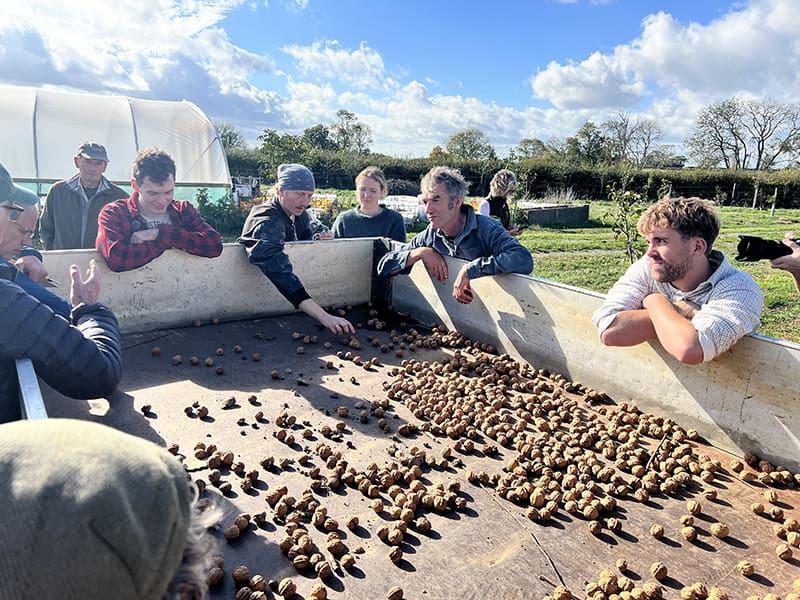
For experienced walnut grower and trial partner Tom Tame, the X15 offers considerable promise. As he observed, “There’s no such thing as a perfect machine, but it is the ideal machine for British conditions, where you have the volume that you need to harvest to be profitable.” His assessment highlights the importance of matching machinery to both local conditions and the scale of production.
While the harvester was the main attraction, a tour of Glastonbury Nut Farm revealed some of the wider challenges of growing nuts commercially. Visitors heard about the difficulties of establishing young trees and the decisions involved in managing a productive orchard.
Recent dry conditions have been particularly challenging, contributing to poor growth and losses among young hazels. The team has been experimenting with different approaches to managing vegetation around the trees, including clover-rich swards, cover crops and mulching. These have brought some unexpected lessons. Reflecting on the use of clover as a living mulch, Andrew Kent, farmer at Glastonbury Nut Farm, admitted, “I thought having a living mulch was better than having constantly applying dead mulches. I was probably wrong.” Although the clover added nitrogen, it also competed with the young trees for moisture. The farm has since adopted an approach of cutting vegetation between the rows and using it as mulch around the trees.
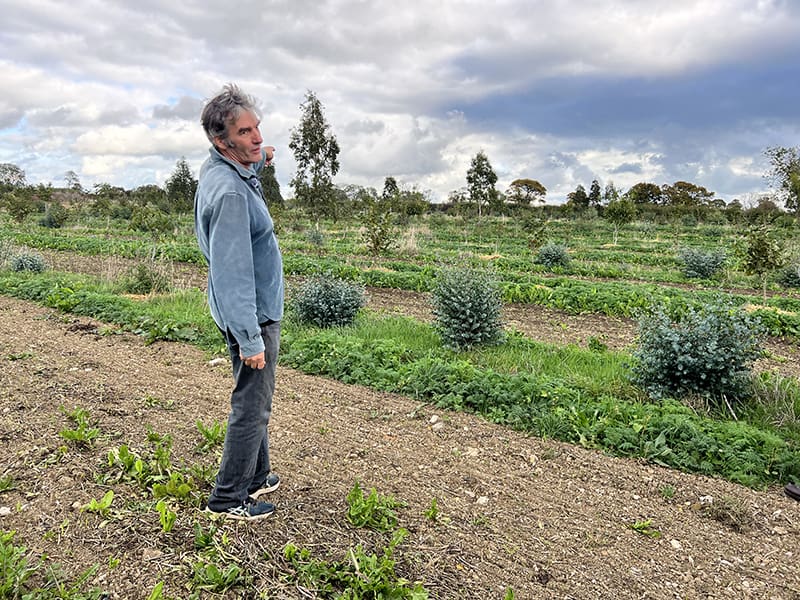
Choosing the right varieties presents another challenge. The team has observed considerable differences in early growth between hazelnut cultivars, while the shape of the nuts themselves could affect how easily they can be processed mechanically. During the tour, Andrew Kent and experienced walnut grower Tom Tame also discussed the potential for grafting onto Turkish hazel rootstocks to reduce the labour involved in removing suckers. These decisions could have lasting implications for orchard management and commercial viability.
The tour also revealed the farm’s wider environmental ambitions. Alongside developing irrigation infrastructure and experimenting with soil management, the farm has been creating ponds to support wildlife. While standing next to the pond at their main site, Andrew Kent explained “on our other site we’ve dug eight ponds already”, with plans for further pond creation. He emphasised the importance of these habitats: “It’s really important if you’re going to plant trees that you create this most lovely diverse environment, and ponds are a pretty key part of it.”
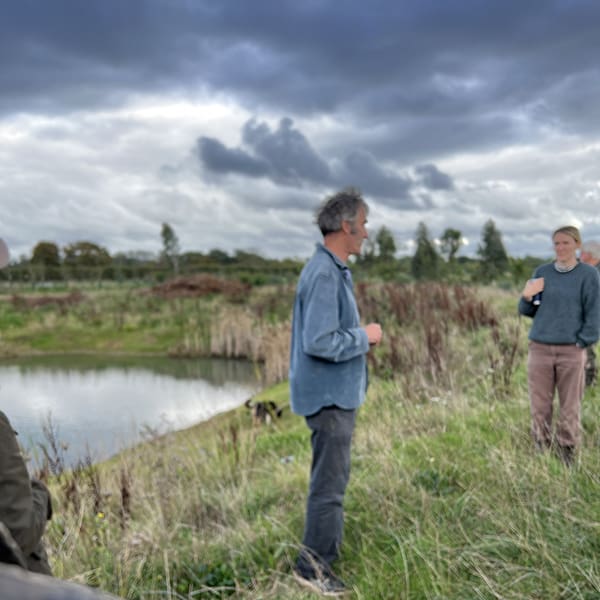
Throughout the tour, the team spoke openly about what had worked, what hadn’t and the questions they were still trying to answer. The discussions highlighted the value of testing different approaches and sharing practical experience, particularly in a sector where established UK examples remain relatively limited.
One of the most exciting parts of the day was hearing about Glastonbury Nut Farm’s longer-term ambitions. Harvesting is an important challenge, but developing a viable British nut industry also requires processing facilities and reliable markets.
Laurie Kent explained during the presentation that many commercial buyers want ready-to-use kernels rather than nuts in their shells. Cleaning, drying, grading and cracking require specialist equipment and considerable investment, which can be difficult for individual growers to justify.
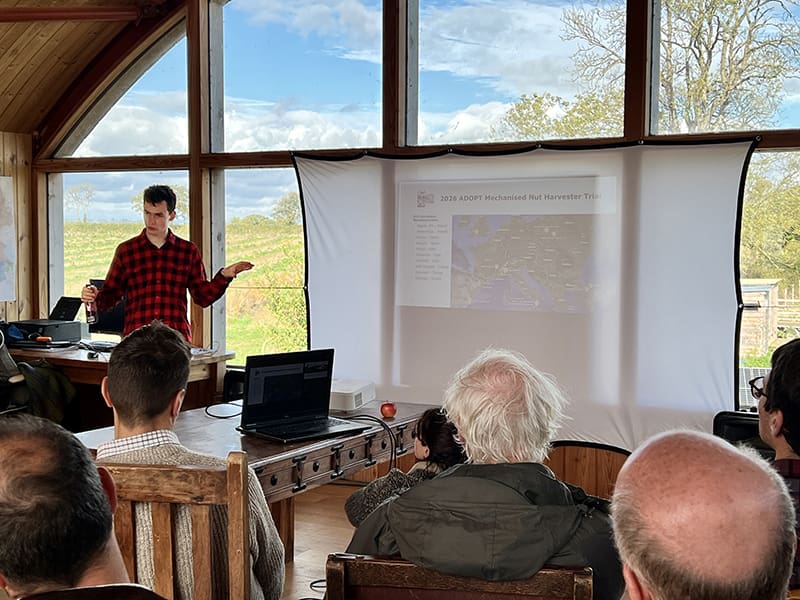
Glastonbury Nut Farm is therefore exploring plans for shared processing facilities that could serve a wider network of British nut growers. The proposed approach would initially combine its own harvest with nuts from selected European growers, helping establish processing operations while British orchards mature. Over time, the ambition is to increase domestic supply through a cooperative model, allowing growers to access processing facilities without investing in their own.
This approach resonated with attendees. Adam Alexander is a grower and author of the Seed Detective, and today as an event attendee he emphasised the importance of supporting local economies: “This is not about empire building and making, whether it’s wheat or nuts, a commodity. It’s about actually how do we build out to support our local economies.”
Experienced walnut grower and trial partner Tom Tame also emphasised the importance of collaboration, drawing on his own experience of supporting other nut growers: “You need more of a network, more support. And we do need regional networks or hubs, even if it’s just a hub of knowledge. Shared facilities for certain aspects of the nut business would be beneficial.”
It wasn’t just Glastonbury Nut Farm’s work that made the day special, but also the range of knowledge and experience brought by those attending. Discussions extended well beyond the harvester, with attendees sharing insights on how climate change might affect future pest pressures, the opportunities for integrating livestock and other crops into nut orchards, and even the potential for robotic harvesting in the future.
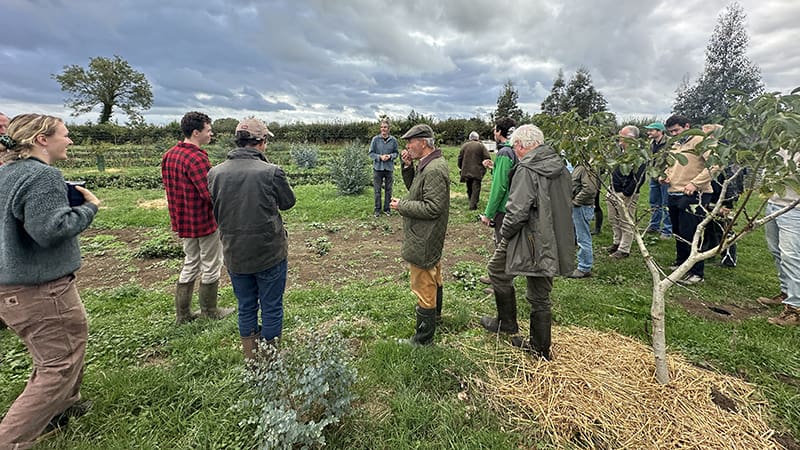
For Paul Henman, a local farm consultant considering planting nut trees himself, the diversity of knowledge was particularly encouraging: “It’s fascinating the amount of knowledge that’s turned up at this meeting, and the diversity of stuff that’s going on here with different people with different knowledge.”
These exchanges highlighted the importance of sharing both successes and setbacks. With commercial nut production still relatively uncommon in the UK, learning from the experiences of existing growers could help others avoid costly mistakes and make more informed decisions about establishing their own orchards.