
Health is very important to us at the Organic Research Centre. Recently we took another look at our vision and values. Our vision remains unchanged: Together we’ll deliver the transition to naturally healthy and resilient farming systems. One of our key values is ‘Rooted in organic principles: Our work is underpinned by the organic principles of health, ecology, fairness and care.’
The IFOAM Principle of Health points out that the health of individuals and communities cannot be separated from the health of ecosystems – healthy soils produce healthy crops that foster the health of animals and people. But what does the principle of health actually mean to farmers and growers?
This was something that was investigated in a series of projects led by ORC between 2013 and 2020 funded by the Ekhaga Foundation. See: Developing best practice networks of health in organic agricultural systems. Though I was not involved in the project directly I found the process and the ouputs fascinating. It was ground-breaking – getting farmers and growers together to talk, not about yields, controlling docks or grazing practices, but concepts of farm system health! I would have liked to have been there! I found the Towards Farmer Principles of Health statements an inspiration, a triumph of collective and participative working which deserves to be better known. I included the statements in my book. So, I was keen to catch up with some of the people involved in the project and hear their reflections ten years on.
Project leader Anja Vieweger who is now at FiBL said:
For me, the central message of the Farm System Health project series is that a healthy farm is a connected living system. Soil, plants, animals, people, biodiversity and the wider environment all influence and depend on one another. Understanding farm health therefore means looking beyond yield or any single measure, and considering how the whole system works.
One of its most practical achievements was the development of ten statements setting out farmers’ own principles of health. Over a period of two years, 16 farmers from Austria, Germany and the UK worked together to put into their own words what makes a farm healthy and what farmers can do to maintain and improve health across their systems.”
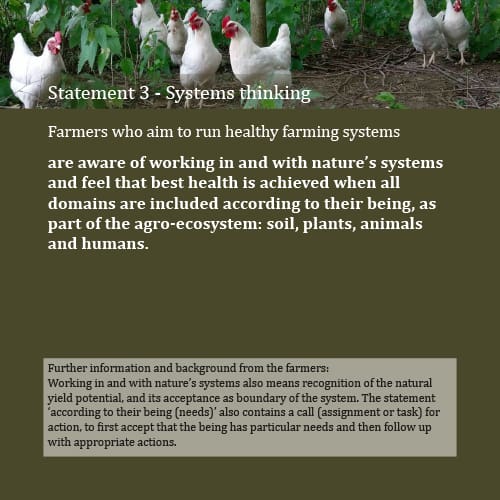
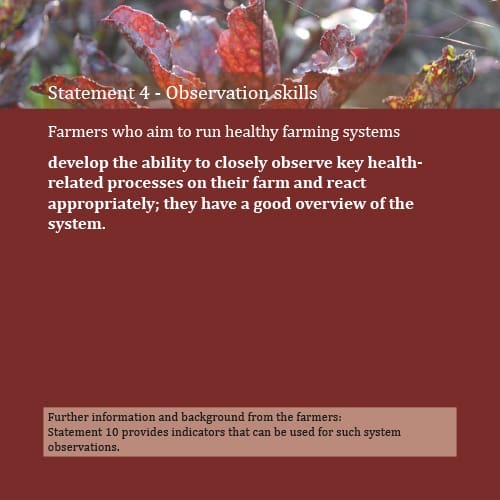
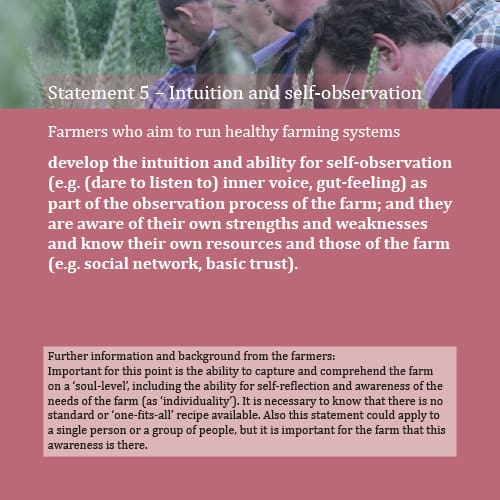
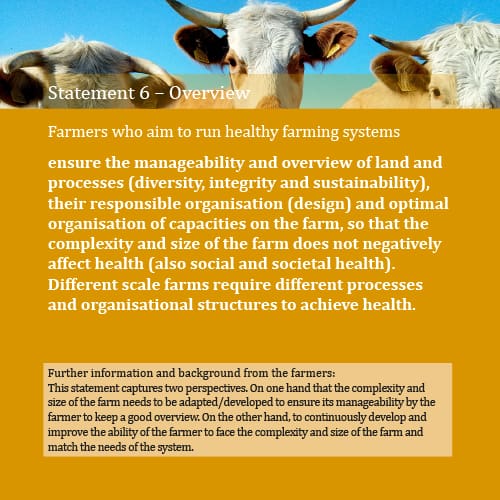
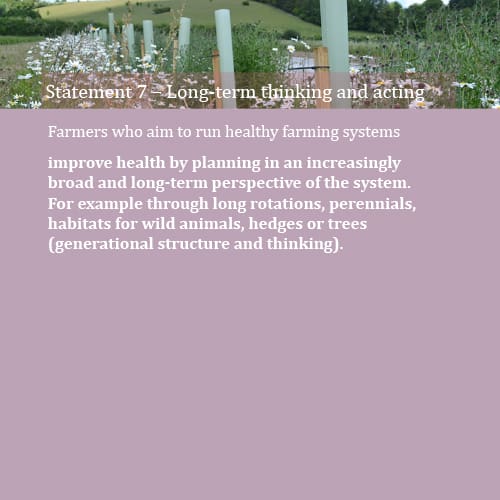
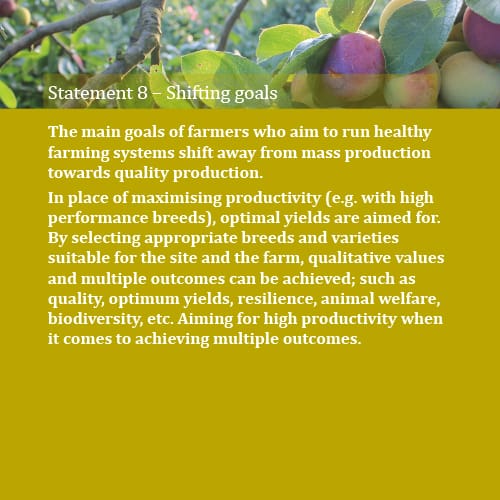
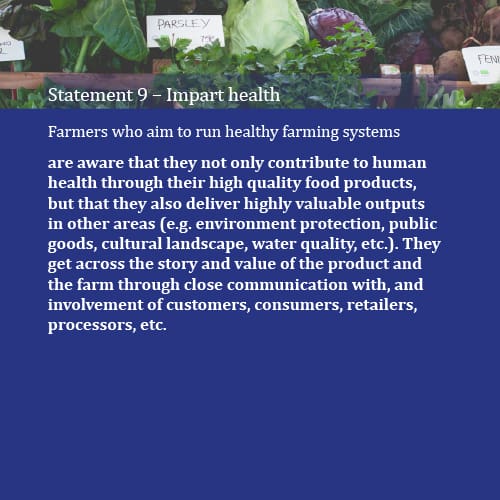
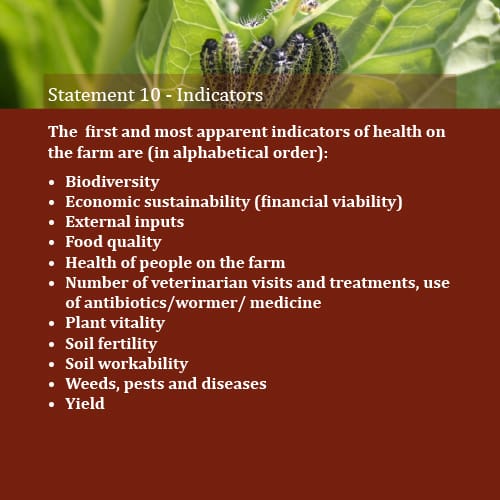
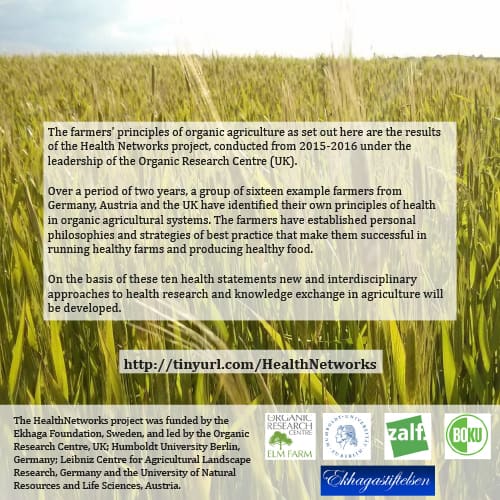
I found it enormously stimulating and motivating to see this work take shape. I facilitated the farmers’ discussions through a series of workshops, sometimes working across different languages. What impressed me most was their enthusiasm and commitment. They would spend a long time finding the right word or the most useful way to describe an idea, because it mattered to them that the statements reflected their shared experience. The result was a set of principles they could all stand behind. I have rarely witnessed a project generate so much enthusiasm.
The farmers saw the ten statements as interdependent. A farm might be rich in biodiversity, for example, but this does not automatically mean its soil or the people working on it are healthy. The statements encourage farmers to look at the whole picture and consider where there is room for improvement.
To help put the principles into practice, the farmers developed questions for reflection: Is there a long-term soil-monitoring plan? Is there a strategy for biodiversity? Are crops and varieties suited to the local environment? Questions like these offer a practical starting point for reviewing a farm, setting priorities and tracking progress over time.
The project also tested farm-school events to share these ideas more widely. The experience showed the value of giving farmers time and space to learn together. The proposed approach brings small groups together regularly, visiting different farms, exchanging experiences and inviting outside expertise when useful. It recognises that lasting change grows through trust, observation and honest conversations about both successes and challenges.
These principles remain highly relevant as farmers respond to climate change. Although the project did not directly test climate adaptation, its whole-farm approach offers a useful foundation. Practices such as conserving soil moisture, diversifying farms and integrating trees into farming systems have since been identified as effective climate adaptation options in particular contexts.
The project’s lasting contribution is to bring practical action and shared learning together: observe the whole farm, work with its natural conditions, learn from others, and keep reviewing what works and what doesn’t. This gives farmers a positive basis for building healthy, adaptable farms for the future.
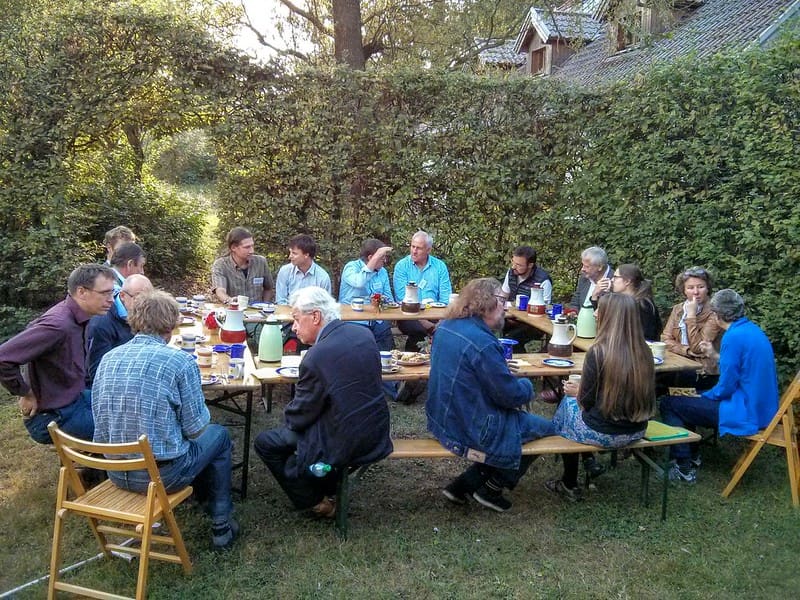
This project worked on several levels. Once we found our confidence to speak, it was like a dam bursting, and everyone had something to contribute. It worked for us at a personal level, giving us the opportunity to listen, learn, and express ourselves in a way that was both creative and cathartic.
Although there were language barriers, common themes developed, and these were admirably captured by Anja and her colleagues. These themes broadly overlapped with one another, correlating with the ‘one and indivisable’ nature of the organic movements’ vision, and that was exciting to witness, and left us all feeling recharged and refreshed.
The longest lasting impact of this project, for me, has been the recognition that the lens through which organic farmers view the natural world is deeply human in scope and scale. This project was warm hearted, generous in spirit, and a great example of what international collaboration can achieve.
I like to think that, even before the project, we thought about health in everything that we do across the farm in terms of our soils, the wider aspects of farming, the way that we farm with a long-term view. What the project did was it focused on that and it was ‘well we think we do this, but actually are we doing it in all the aspects that the project tackles?’
We’re not necessarily getting everything right and things have changed since the project which have made us think a little bit shorter term in terms of the economics of what we’re doing. But in the back of my mind, it’s always, ‘what is the right thing to do in terms of producing a healthy system?’, which was brought to the forefront by doing the project.
I was at a large farming estate recently and the head guy there said that rather than just relying on gut feeling, they were analysing whether or not these things were actually happening. Statement 5 – Intuition and self-observation – stresses the importance of listening to inner voice, gut feeling. Even though gut feeling is really important, I think to investigate that gut feeling to see if it actually translates into anything material has probably become more important, which means focusing more on the detail. So, I think that would be the change I would make to the statements, not just to rely on gut feeling; are we actually physically making the changes we think we’re making?
The Farmer Principles of Health are definitely embedded in our farm team, we just need to make sure that we are doing what we think we’re doing. Because we run our business along the lines of an embedded health and safety policy, an embedded organic adherence and an embedded red tractor, I came to the conclusion that maybe it was time to re-look at all this stuff. How we adhere to all these assurance schemes happens every single Monday morning when we sit down and have a meeting – it’s on the rolling agenda E.g., ”Are we continuing to do what we think we should be doing in terms of how we’re treating our soils?’.’
Ten years ago when we did the project, the economics of farming were in a very different place in terms of value, but also in terms of how much it cost us to produce a tonne of wheat. Things have changed drastically since then, and it would be quite interesting to refocus on that profitability element in terms of where we are now and where we were then.
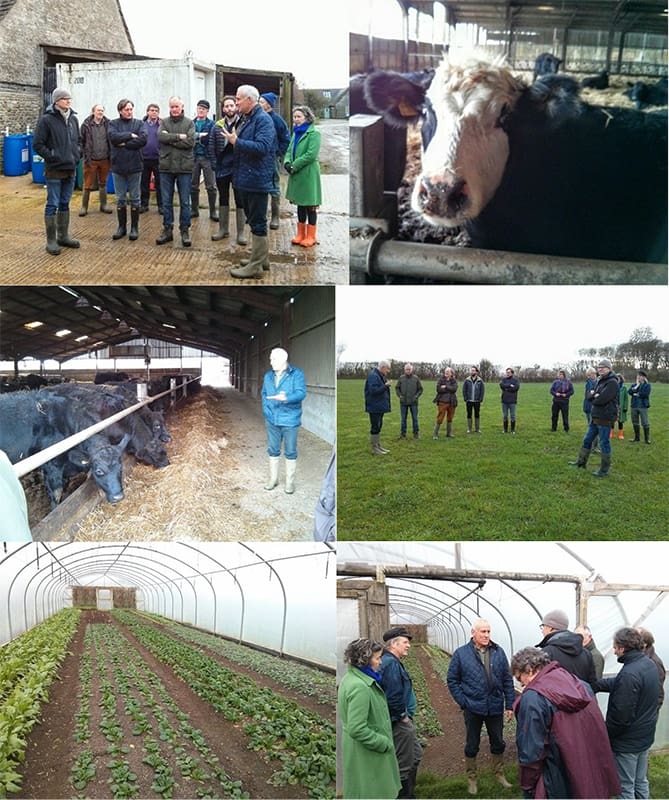
It was a pivotal piece of work, really. Thanks to Anja for bringing it together and keeping it together, working with a pretty disparate group of growers and farmers and trying to organise them. I think the output was really worth it.
One thing that came to mind was that we didn’t actually study the four principles of organic farming as set out by IFOAM (Health, Ecology, Fairness and Care) at the start. I am always amazed at how many organic producers have never even heard of them!
(Developing the 10 Statements) was a fantastically useful exercise for me because it reinforced many of the things I felt were important, but I wasn’t sure what they really were. And when you get a whole group of people together and do a brainstorming session and you come up with the sort of detail we came up with, I think it was quite revealing. It was a collective force that came up with this.
It was the holistic, whole systems approach which really counted because a lot of people do still look at their systems in little boxes and don’t join the whole thing up together. I think it stands the test of time. These 10 statements have laid down some really relevant and important points that farmers and growers really should be revisiting on an annual basis just to check how they’re doing. We need a tick box questionnaire based around this to remind producers of what their responsibilities are beyond just making sure you get your organic certificate every 12 months, because the organic certification doesn’t really cover this much.
I think it does reinforce where producers really need to be in terms of their thinking of the way their farm operates. And I think it’s easy to sit here on a rainy day and philosophise about this, but the reality is that when you get out there, you’ve got a really difficult season, and a lot of the rest of it goes out the window. But a lot of this is relevant to how your crops will behave and how you as a person and your staff will react in that situation. I think the holisticness of what these statements imply is really important. A lot of people don’t have an understanding of the wholeness of their system, and I think they suffer as a result of it. So in a way, it’s almost a kind of counselling, helping people through what I know are very difficult times in terms of the weather or markets or any other things they’re dealing with on their phones. I think to study these for these 10 statements does help you to understand
your place within that.
I think some people were slightly cynical about talking about gut feeling and intuition, as you can’t measure it. But, there’s a whole lot of stuff in organics you cannot measure. There is a real need to get people to understand how important their gut feeling and their intuition is, because that will get them through.
I don’t remember any discussions around mental health which I think is an omission because the whole situation within organic producers and markets has got more difficult in the last 10 years, and I think the mental health issue is ramping up. Maybe there’s a case for a revisit to these statements and seeing if there’s anything that needs to be changed from 10 years ago.
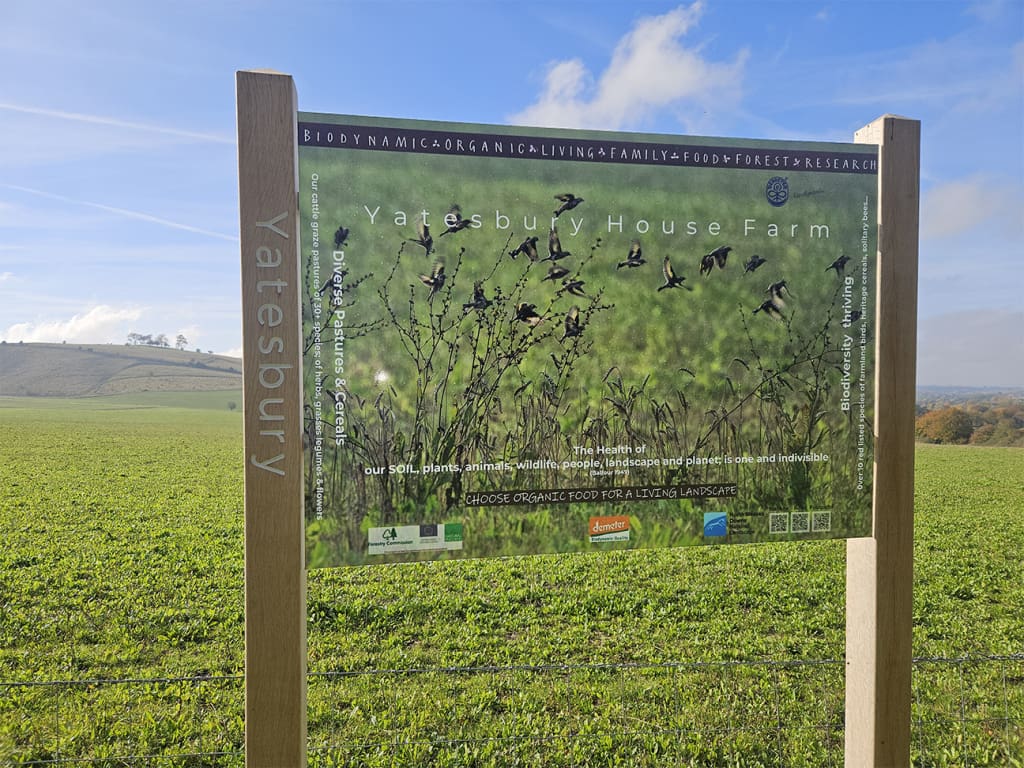
I loved the whole project and have constantly used the little leaflets that resulted. I was the only biodynamic farmer from the UK, which wasn’t surprising but a lot of the farmers from Austria and Germany were biodynamic. That definitely influenced the conversation, from my perspective, in a really positive way.
The intuition and self-observation statement was our gentlest way of bringing in that connection with nature. Albert Einstein said “The most valuable human skill is intuition” and that all his inspiration came from intuition and then he validated it afterwards. And so I think that there’s an important validation process which comes with experience. But, it’s actually much deeper. An intuition or gut feeling is actually just a code, a common understanding for something that we are working in constantly, a completely different level of connection with nature. As biodynamic farmers we’re looking for nature to be the farmer and us to be guided and to guide the process, quite a different way of thinking.That means a real connection with nature, an ongoing communication, not looking one year, five years ahead, it’s an infinite perspective.
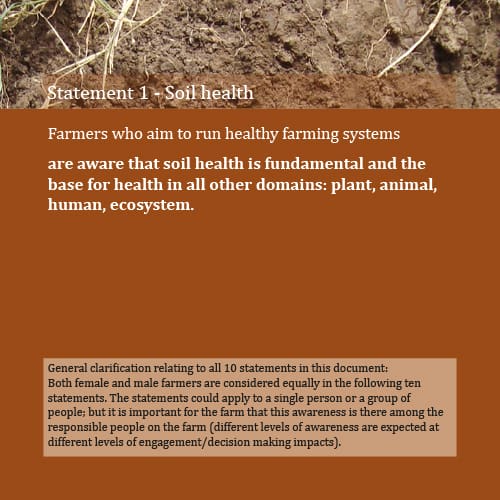
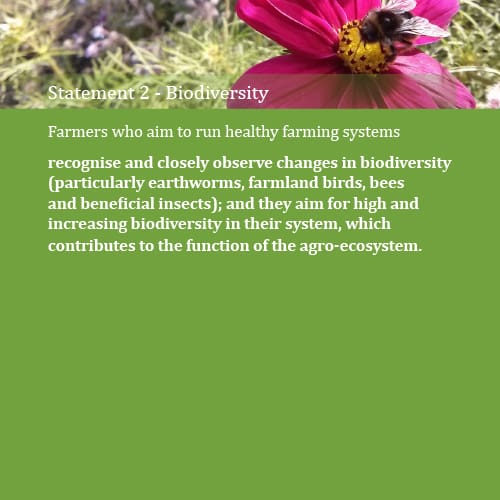
It starts with the life in the soil. That’s where we’ve always set our initial goals and everything sprung from that.Through my PhD research, I found that life in the soil comes from biodiversity. Not just biodiversity, because biodiversity has this idea of being species in separation. But actually it’s not. They’re all communicating, they’re all joined together. In our fields, the plant, the different species are joined up through the mycorrhizal fungi network and sharing resources.
That’s what’s been really exciting – in every dry Summer we’ve had since 2022, when we first noticed it, is the ability of the different species, deep rooting and shallow rooting, to stay vibrant and green, and therefore they must be sharing resources. No matter how hot and dry it is out in the fields. This health is then shared with the cattle. Whereas our neighbours’ fields were parched with cattle standing out in 35° full sunshine, ours had access to good pasture and woodland for shade, browsing and shelter all Summer. It’s about being in that process and thinking about the farm as one whole farm organism, which biodynamic farming does, and thinking about everything all the time – which is encompassed in Statement 6 – Overview, and in Systems thinking. Not forgetting the organic principle automatically included, that we start with no nasties, no pesticides, so the communication mechanisms are open and not blocked.
It’s about community, not just biodiversity, and that comes to people as well, in how people are engaged in the farm, in the community, in the landscape, and beyond.
Observation skills are really important and I talk to all our students and anyone who comes to the farm about three things. Seeing, observing, and perceiving being three separate processes and getting people to understand what the difference is. It’s much more than observation, it’s perceiving. It’s being able to look at a field, see what’s in front of you, observe the processes, and then perceive what you can’t actually physically see. That’s the real trick with experience, that shows you that you can see a lively plant and therefore the roots are really active in the soil. The soil isn’t compacted because you can see the life processes going on above ground, so you can perceive what’s going on out of sight. In a way, the intuition and the observation joining up the two principles of intuition and self -observation and the overview. You then create a whole another level of seeing, which is beyond what’s visible. So that’s really, you know, one of those important differences that we could explore if we were visiting this again.
Continuity is another principle that’s not mentioned – who’s going to manage and be guardians of the land for the next generation. What I see is many farmers’ offspring not interested in farming because the farmers themselves don’t have any enthusiasm for farming. Why would the next generation be keen to carry on? That’s has to be a really important aspect that probably was overlooked and I would want to be included. There’s a phrase, a military phrase, I hesitate to say, which is hearts and minds. It’s about if people are in the right heart and mind about these things, then everything changes, all these things come along, the care and the enthusiasm etc.
Although the economic ability of an organisation to be persistent and ongoing is clearly a fundamental principle given in the results as an indicator, I wonder whether we have lost sight of the fact that money was only set up to be a means of exchange and not the goal. When you’re thinking on a different level and in a different philosophical state of heart and mind, can we find ourselves in a different economic paradigm where Balfour’s whole health is really valued?