
The GreenGrass project team had been looking forward to the Royal Welsh Grassland Event for weeks, reports Philippa Hall.
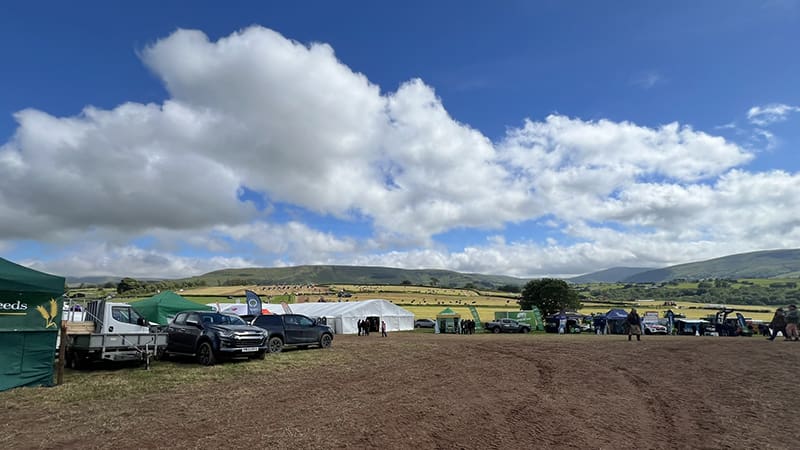
It didn’t disappoint.The setting at Cwmbrynich Farm, near Brecon was amazing – surrounded by rolling hills with rows of flags, massive marquees, and a horizon dominated by agricultural machinery and demonstrations. The air was thick with the rich, sweet, unmistakable scent of fresh-cut grass.
Dr Julia Cooper joined me to promote the GreenGrass project which fitted well with the event theme ‘Sowing Today for a Greener Tomorrow.’ The absolute highlight was the reception to our project film from the event committee and visiting farmers. Watching a crowd of focused, practical farmers stand together, completely engrossed, was incredibly moving. The film, due to be released later in the year, is designed to be an educational tool – something to help farmers look at their land differently and make truly informed, confident decisions for the future of their businesses. Seeing them nod along, ask pointed questions during the panel session, and genuinely engaged showed us that the gap between research and the reality of the farmyard isn’t a gap at all; it’s a bridge we are actively building.

It provided the perfect backdrop for our incredible lineup of speakers in the session led by Dr. Julia Cooper “There is no magic bullet,” said Julia Cooper; it’s about getting the fundamentals right: soils, grazing and using nutrients more efficiently. Elaine Jewkes, Soil Sense, Paul Newell-Price, ADAS and Chris Duller took to the stage, and their collective energy was infectious. Elaine brought incredible clarity to the realities of nutrient management, Paul broke down the complexities of establishing robust legumes, and Chris kept everyone grounded with his trademark practical, farm-focused advice “Nitrogen is not the devil’s work. Nitrogen in the right place is the most cost-effective investment you’ll ever bring onto your farm.” – Chris Duller.
Segments of the panel session will be made available on the GreenGrass project page soon so please watch this space.
We met scores of farmers who were genuinely excited about the GreenGrass project, deeply curious about what ORC is doing to support sustainable farm businesses, and eager to sign up for future projects.
For a first-time outing, this event proved that the agricultural community is hungry for innovation and ready to embrace changes that benefit both the land and the bottom line. It was an unforgettable introduction to the scale of Welsh grassland farming, and hope to be back next year.
See Instagram reel: “It’s about looking at the bigger picture.”
Independent grassland specialist Chris Duller explains that while there is often an opportunity on many farms to start reducing synthetic nitrogen use, it’s essential to have healthy soils and strong grazing management in place first. He also points out that in some cases, it may make more sense to cut back on bought-in feed instead. With the right foundations, many farms can still grow plenty of grass without relying heavily on synthetic nitrogen.
See: Behind-the-scenes moments from the Royal Welsh Grassland Event, where Nigel Akehurst (Indie Farmer) was filming for an upcoming documentary exploring one of the biggest challenges facing UK livestock farmers: how to reduce reliance on bagged nitrogen fertiliser without compromising productivity. https://www.instagram.com/reel/DZnR8E5oumQ/?utm_source=ig_web_button_share_sheet