On Tuesday 25th November MPs, peers, government officials and growers gathered at an event in Parliament to celebrate the launch of the UK Fruit and Vegetable Coalition. The event was sponsored by Liberal Democrat MP Ed Morello, and was well attended by notable political figures including the former Defra Secretary Daniel Zeichner MP, Jeremy Corbyn MP, Kerry McCarthy MP, Baron Marvin Rees, and others.
The Coalition set out how strengthening domestic fruit and vegetable production can improve public health, support nature and build a more resilient UK food system. Over a seasonal organic lunch, members of the Coalition showcased the potential of organic and agroecological horticulture to help deliver the UK Food Strategy 2025.
The UKFVC comprises grower organisations, organic bodies and wholesalers pioneering routes to market that deliver a better return to farmers. Together, these organisations represent thousands of businesses, including organic, agroecological market gardens, orchards and farms across all scales, as well as vegetable box schemes, independent retailers and food hubs.
Edward Morello MP, who sponsored the event, said:
“I am delighted to be able to support the launch of the UK Fruit and Vegetable Coalition. By bringing together stakeholders from across the supply-chain we can ensure there is a voice for fresh organic produce in Parliament and society, and help deliver a healthier future for Britain.”
Edward Morello MP at the UKVPC launch. Photo: Jonathan Goldberg
The event takes place against a backdrop of challenges to UK diets. Only one in three adults, and just over one in ten children, meet the recommended five a day. Meanwhile the UK imports around 85 percent of its fruit and nearly half of its vegetables, leaving the nation exposed to supply chain shocks and climate-related risks. However, less than 2 percent of land in the UK is currently used to grow fruit and vegetables, and many growers report that financial pressures mean they may be forced to close within the next year.
Organic and agroecological growers are already contributing to the National Food Strategy’s vision for a “Good Food Cycle”. Research from the Organic Market Report shows demand for organic fresh produce rose by just over 10 percent between 2023 and 2024, and the organic market has grown for thirteen consecutive years. Yet only 3.5 percent of England’s farmed area is organically certified, and demand for produce is currently supplemented by imports.
UK Fruit and Vegetable Coalition Chair Steven Jacobs said:
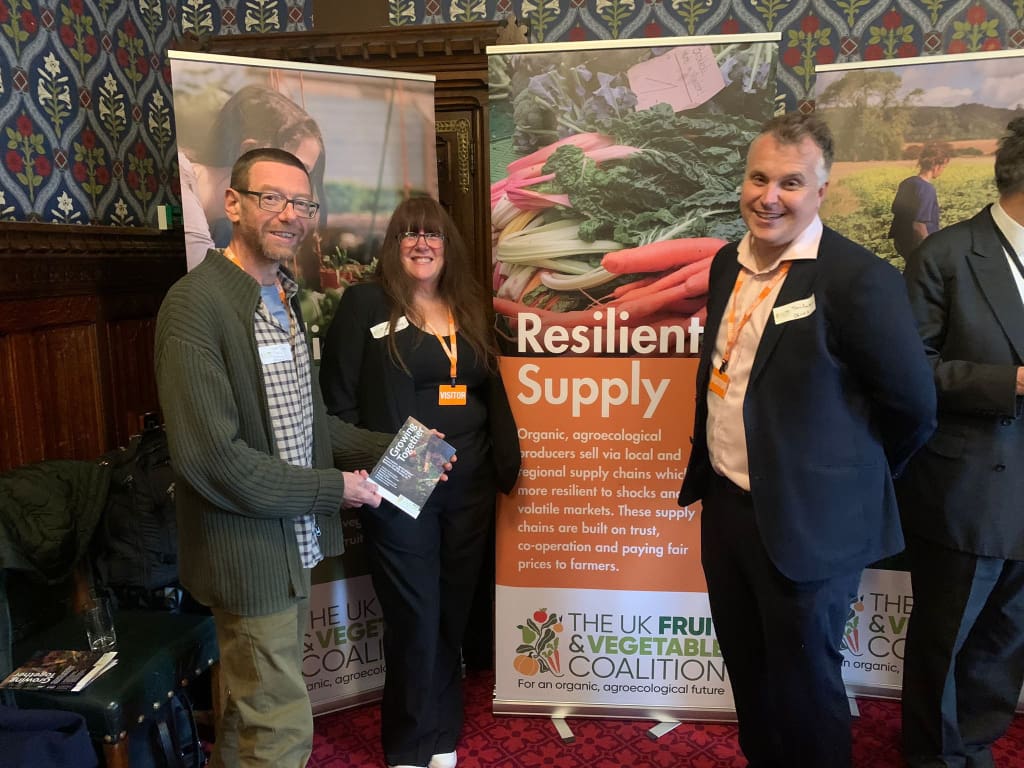
“The UK’s organic, agroecological fruit and veg growers are already delivering multiple wins for health, climate, nature and the economy, but they need support. Our launch today, against the backdrop of the climate and nature crises, is an invitation to the Government to harness the power of the fruit and veg sector for a healthier, greener and more food-secure future for the UK.”
Steven Jacobs (left) with Growing Together policy pamphlet. Photo: Maddy Potter Wood
To mark the event, the UKFVC published a new policy pamphlet Growing Together which – by profiling growers and setting out a list of joint actions and policy recommendations – shows how organic, agroecological growers can help to deliver on multiple aims within the National Food Strategy; from plugging ‘The Resilience Gap’, transitioning towards a ‘Good Food Cycle’ and building skilled workforce within the food and farming sectors.
The event shone a spotlight on growers who are already supplying local communities with fresh produce, and challenging assumptions that low-income households do not buy organic produce. At Growing Communities, a fruit and vegetable delivery scheme in Hackney, over 8 in 10 veg bag customers eat five to ten portions of fruit and vegetables a day, well above the national average. Bridging the Gap, a Sustain-led project piloting ways to make organic fruit and vegetables more accessible to people on low incomes also launched their findings at a sister event on the same day.
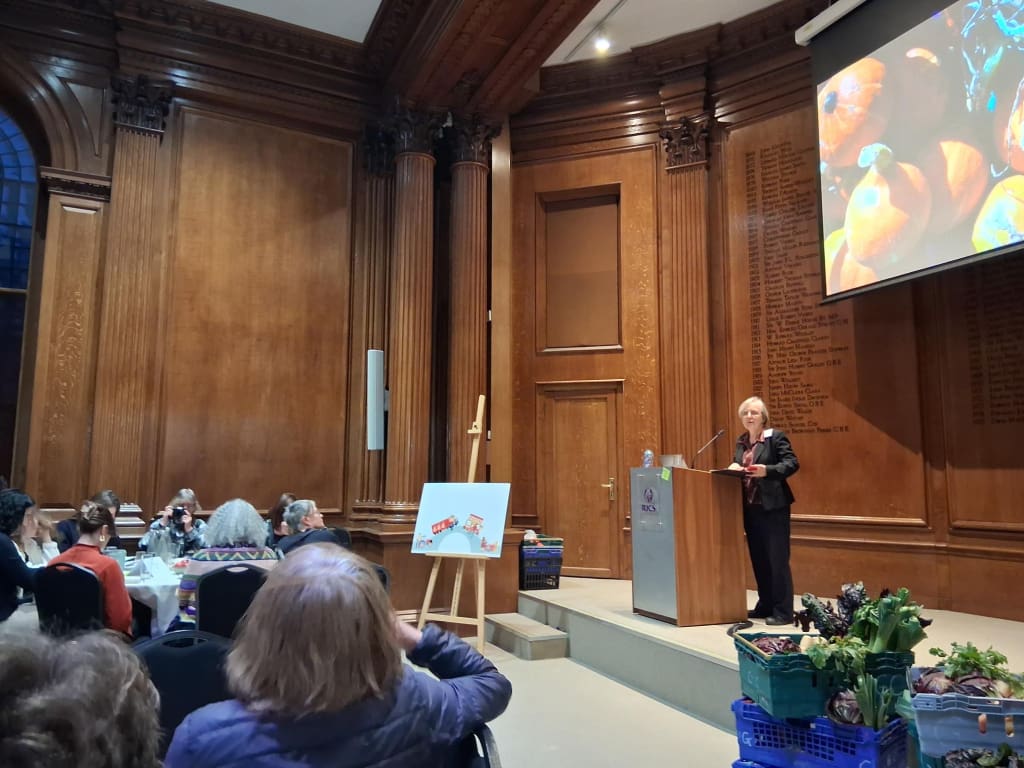
Kath Dalmeny, Chief Executive of Sustain talking at the Bridging the Gap event.
ORC has been contributing economic analysis to the project pilot, building a clearer picture of the benefits coming from more equitable, agroecological supply chains.
Sign up to ORC’s e-bulletin and be the first to receive updates from our in-the-field research and the latest organic and agroecological news and events. Delivered to your inbox monthly.
Subscribe
Manage Consent
To provide the best experiences, we use technologies like cookies to store and/or access device information. Consenting to these technologies will allow us to process data such as browsing behaviour or unique IDs on this site. Not consenting or withdrawing consent, may adversely affect certain features and functions.
Functional
Always active
The technical storage or access is strictly necessary for the legitimate purpose of enabling the use of a specific service explicitly requested by the subscriber or user, or for the sole purpose of carrying out the transmission of a communication over an electronic communications network.
Preferences
The technical storage or access is necessary for the legitimate purpose of storing preferences that are not requested by the subscriber or user.
Statistics
The technical storage or access that is used exclusively for statistical purposes.The technical storage or access that is used exclusively for anonymous statistical purposes. Without a subpoena, voluntary compliance on the part of your Internet Service Provider, or additional records from a third party, information stored or retrieved for this purpose alone cannot usually be used to identify you.
Marketing
The technical storage or access is required to create user profiles to send advertising, or to track the user on a website or across several websites for similar marketing purposes.