
Agroforestry is predicted to protect English arable crops from climate change, but Colin Tosh suggests that the reason why may surprise you
There has been a lot of work examining how trees in fields can modify factors such as temperature and humidity, which are important for the yield of arable crops. There has been less work investigating how agroforestry modifies or modulates actual yield in the face of climate change, but some studies do exist. This is what we have attempted to do for English silvo-arable agroforestry in a paper in the journal Agronomy for Sustainable Development.
Researching issues such as climate change requires us to project into the future, and for this we need models. We used a model called Hi-SAFE, developed by a French team in Montpellier. It is a highly detailed model of the interactions between trees and crops, and we parameterised it for a typical field scenario in the East of England lowlands.
We found that the wheat response to in-field trees was largely the same under both low- and high-intensity warming scenarios. Typically, about 5% of yield is lost to trees each year due to competition. However, in extremely bad years, when yield crashes in monoculture systems, trees have a protective effect, helping to maintain a reasonable yield. In peas, trees appeared to provide a stronger protective effect as the intensity of warming increased.
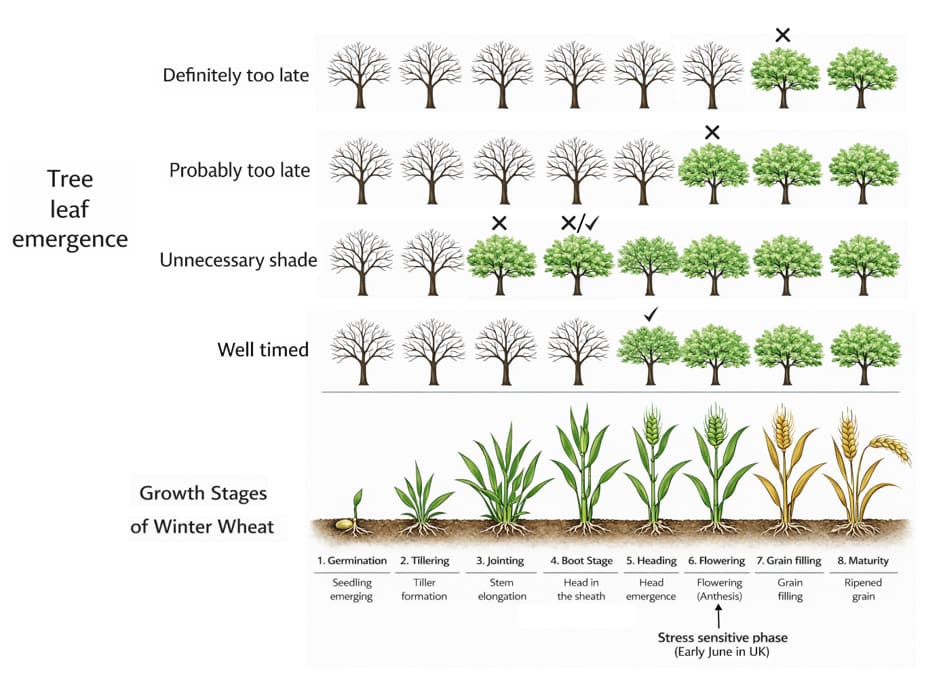
Using advanced statistical methods, we were able to determine the mechanism underlying this protective effect of trees on arable yield, and when it occurs during the growing season. The results surprised us. One might assume that agroforestry protects yield from climate stress during the hottest periods of the year, at the peak of summer, but this does not seem to be the case. We found that the key period for this protective effect is relatively early in the season, around the start of June when wheat flowers and is known to be extremely susceptible to stress. If wheat is stressed during this flowering period, yield tends to be reduced. What we found was that the leaves of the trees we modelled (walnut) emerge about three to four weeks before wheat flowering occurs. This just in time and they provide the necessary shade and increase in humidity that the crop needs during these stressful periods.
These results led us to propose the guidance shown in Figure 1. We suggest that farmers with winter wheat as a regular part of their rotation should carefully choose agroforestry tree species based on the timing of tree leaf emergence. Trees whose leaves emerge too early provide unnecessary shade in the months before wheat flowering, when wheat does not require it. Trees whose leaves emerge at or after flowering are unlikely to provide sufficient protection. The ideal situation is when leaves emerge a few weeks before wheat flowering. This offers a balance between avoiding excessive shade at unnecessary times and providing adequate protection during the critical flowering period.
Which trees are ideal in this respect? In our simulations, we used walnut trees as our focal species, and these appeared to be particularly well timed for protecting winter wheat compared to many other species. Walnuts leaves emerge relatively late, usually well into May, so they do not shade the crop unnecessarily early in the year, while still providing protection during the sensitive wheat period.
Walnut trees and wheat make an interesting combination for many reasons. Farmers often ask, “Why would I put trees on my cropland?” There are several reasons to consider planting walnut trees in crop fields:
So instead of asking, “Why should I plant trees on my cropland?”, it may be worth asking, “Why wouldn’t I plant trees on my cropland?”
“A foundational paper providing evidence of the protective effects of trees in the agricultural landscape. Utilising a rare 30 year old agroforestry system (Wakelyns) as the basis for modelling to provide the evidence that many practitioners already suspected, namely the role of trees in supporting crops in resisting extreme weather.
“Insights from this paper into the timing of leaf emergence and crop flowering provide another arrow in the quiver of future agroforesters. The species used in the modelling, wheat and walnut, highlight the numerous benefits that agroforestry can provide including crop protection, crop diversification, timber production, and biodiversity benefits.
“The use of future climate projections should place the findings of this paper front and centre in the minds of agroforestry designers to develop agroforestry systems which resist against increasingly frequent and severe weather extremes that we are already beginning to feel the force of today.” Christian Gossel, Farm Sustainability Researcher, Organic Research Centre
“Climate change is making farming more difficult, and we are desperate for more information on how to build resilience into our farming systems. This paper is an important contribution to building confidence in the benefits that trees have in this respect.” Ben Raskin, Head of Agroforestry, Soil Association
“Like many farms we came into walnut agroforestry by chance but for the majority of farmers research like this is critical in giving farmers confidence that trees grown in fields isn’t a negative and can in fact be a big positive for the farm, there are many already doing this and seeing the benefit.
As well as the environmental & financial benefits of a second crop (walnuts can be very profitable), the psychological benefits of being amongst trees cannot be underestimated as numerous studies have shown worldwide.” Tom Tame, Warwickshire Walnuts, one of the UK main walnut producers in the UK
Tosh CR, Gossell C, Lecomte I, Gosme M, Eden JM, den Hond-Vaccaro C, Simonson W, Herzog F, Dupraz C (2026) Agroforestry protects arable crops from climate shock during critical early-season phenological stages. Agron. Sustain. Dev.. 2026. Vol. 46(4). DOI: 10.1007/s13593-026-01129-3