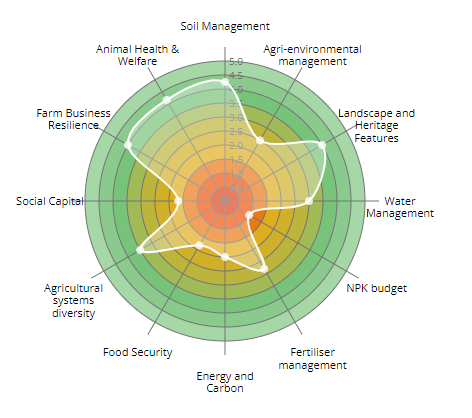
A paper has been published from the FOODLEVERS project which makes use of the Public Goods Tool. The study aimed to identify key features of 8 innovative organic farms, comparing their sustainability across multiple dimensions. The farms performed well overall, especially in business resilience, system diversity, social capital, and soil management. Areas needing improvement included energy use, carbon footprint, and water management. A strong link was found between financial resilience and social wellbeing, showing that economic stability supports community and worker engagement. The authors recommended that future research and policy should focus on holistic sustainability assessments and strengthening leverage points to make farms and rural communities more sustainable and resilient.
den Herder M, Westaway S, Arguile L, Dumper-Pollard R, Borek R, Żyłowski T, Syp A, Pisanelli A, Consalvo C, Ciolfi M, Lorenzoni D, Șandor M, Gliga M, Wustenberghs H, Alonso-Adame A, Michel-Villarreal R, Orfanidou T, Noble N, Holzner V, Riekötter N, Smith L (2025) Evaluating the sustainability and leverage potential of innovative organic farming systems, Sustainable Production and Consumption. Volume 57, 2025, Pages 388-402, ISSN 2352-5509, https://doi.org/10.1016/j.spc.2025.05.021.
Modern agriculture has advanced food security but at an environmental cost. Organic farming and agroforestry have been proposed as alternatives, however, evaluating their sustainability is challenging due to heterogeneity of the sector, a relatively small number of sustainability assessments carried out and lack of user-friendly assessment tools. Holistic sustainability analyses, including ecosystem services provided by farms, are essential to evaluate food and farming systems and inform policies. In this study, we aim to identify key characteristics of innovative organic case study farms and evaluate how innovative organic farms compare across multiple dimensions of sustainability. In addition, the study aims to identify key leverage points within these farming systems and evaluate how these influence sustainability performance in environmental, economic, social and governance domains. Farm performance was evaluated using the Public Goods tool which is a sustainability assessment tool for evaluating different aspects of sustainability at the farm level. The findings from eight organic farming case studies showed good sustainability performance in most of the examined sustainability aspects, with areas for improvement in energy, carbon, and water management. The farms scored highly in farm business resilience, system diversity, social capital and soil management. There was a strong positive relationship between “farm business resilience” (e.g. sources of farm income, satisfaction with farming system) and “social capital” (e.g. training of farm workers and community involvement) suggesting a possible relationship between financial and economic factors and social wellbeing. In addition, all case study farms demonstrated a clear objective for their operations and a strong vision for enhancing sustainability. This was reflected in their high scores for the leverage point categories of ‘design’ and ‘intent’. To achieve their objectives, farmers proactively sought knowledge to guide system design decisions. They also engaged in knowledge sharing, social and community engagement through networks, and direct marketing to inform and ‘reconnect’ peers with food and farming systems, while reducing reliance on long supply chains. Future research and rural policy should work together and focus on how to operationalize holistic sustainability assessment and key leverage points to make farms and rural communities more sustainable and resilient to both expected and unexpected challenges.
Keywords: Ecosystem services; Sustainability impact assessment; Leverage points; Organic farming; Agroforestry; Community-supported agriculture