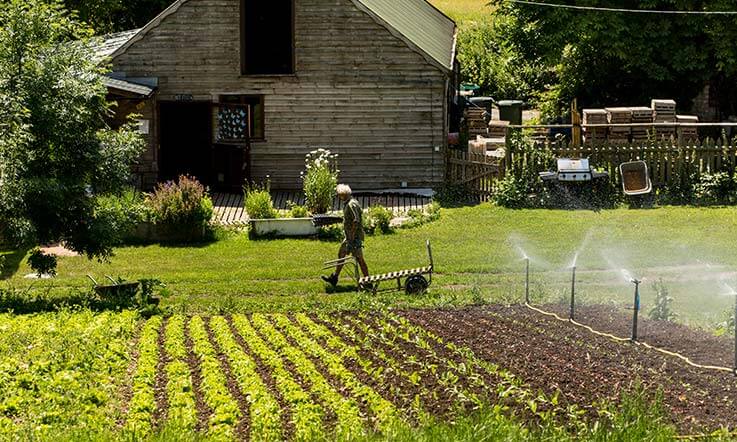

The 2nd Agroforestry Show 2025 took place at the Soil Association’s Woodoaks Farm in Hertfordshire on September 10-11. Agroforestry is a big research theme for ORC and this year we were delighted to be part of the ReForest Training Hub and see the emphasis shift from information to training. Our research team reflects on an inspiring couple of days.

After a stellar debut for the Agroforestry Show in 2023, I was looking forward to the 2025 iteration. The anticipation was palpable on the morning of Day One, least of all because the weather was threatening thunderstorms. Nonetheless, the Organic Research Centre set up in the ReForest Training Hub, an initiative of the ReForest and DigitAF European projects and co-organised by ORC, Agricology and Cranfield University, located in a beautiful 16th Century barn.

Thankfully as the attendees arrived, including farmers, estate managers, researchers, foresters, agronomists, and entrepreneurs to name a few, they brought some good weather along with a wealth of information and experience. Over 1000 tickets had been sold, exemplifying the increasing interest in agroforestry across multiple sectors in the UK.

Across both days there was a wide range of presentations and talks addressing every aspect of agroforestry you’ve thought of and some you never have. The farm walks were particularly popular, providing practical demonstrations on hedge laying, organic conversion, flower picking, and fungal composting.
A particular highlight for me was the session on developing markets for specialist agroforestry products, chaired by ORC’s Rowan Dumper-Pollard. Forest ecologist/medical herbalist Muji shared his journey developing a health tonic from sustainably sourced products, emphasising the importance of understanding where the products you use come from and how they are grown, even if they involve international supply chains. Lou Astbury, founder of From Trees, gave insights into developing niche markets, in her case teas from non-timber forest products and how traditional uses that have declined can be revived to create opportunities for modern agroforestry systems. Last but by no means least, Merry Albright from Border Oak presented on bringing oak-framed buildings back into fashion, highlighting several barriers in modern building policy and regulation that could be addressed to help this niche but traditional technique to become mainstream again.

I left this session, and in fact the whole event, with a feeling of hopefulness that the future of farming and forestry in the UK will be bright. While by no means certain, the enthusiasm, curiosity, and knowledge on show at Woodoaks Farm demonstrated that we can address existing barriers and create a more sustainable food and farming future going forward.

The aim of the ReForest Training Hub was to provide short, accessible introductions to different aspects of doing agroforestry and the tools that can help along the way. Between the different organisers of the initiative, which was new for 2025, we put on 12 short presentations on everything from introductions to silvoarable, silvopasture and boundary agroforestry opportunities, to greenhouse gas calculators for agroforestry and the range of public goods benefits that these systems can bring. There were longer design and planning workshops, including a successful session, led by our Katie Bliss, bringing farmers, researchers and others together to co-design an agroforestry system for Cumbrian farmer Tom Newbury. The breakout areas and stands of ORC, Agricology, Cranfield University, ReForest and the Farm Woodland Forum/Irish Agroforestry Forum created a space for people to mingle, share ideas and make new or renewed contacts.

I enjoyed getting to know Francisco Alves, who I had invited to join us from Portugal where he manages a traditional cork oak wood pasture (montado) integrating four livestock types (cattle, sheep, goats and pigs) in a way that maintains ecosystem health and high levels of productivity. He spoke in the session I chaired on traditional agroforestry on the European continent and the lessons we can learn from it. On the panel we also had Dan Carne who talked about his Churchill Fellowship looking at wood pastures and wood meadows in a range of Eastern and Central European counties, and Rico Hübner from the German Agroforestry Association DeFaF, a ReForest partner. Rico talked spoke of the ways in which traditional orchard management can be and is being adapted to the farming systems of modern Germany. This case study neatly encapsulated the challenge and also opportunity that the Agroforestry Show presented through its two-day programme: revitalising the traditional, and innovating with the new, to meet the economic and ecological challenges of our age.

Trees, training, and a growing movement in agroforestry (Colin Tosh)
One of the standout sessions at this year’s Agroforestry Show was Tree Species Selection for Agroforestry, led by Colin Tosh (Organic Research Centre), Tom Staton (University of Reading), and organic farmer Mark Lea (Green Acres Farm, Shropshire).
The session was lively and interactive, with the audience weighing in throughout via mobile polling. The first surprise? Most participants were farm advisers rather than farmers themselves – a clear sign of growing professional interest in agroforestry.
Tom Staton then invited a farmer from the audience to share their plans, and everyone joined in the challenge of selecting a suitable tree species. Two key tools guided the process: the Tree Species Guide for UK Agroforestry Systems and the app4future online tree selection tool. Interestingly, no single species emerged as the winner – personal knowledge and preference played as big a role as the formal resources.
A light-hearted quiz kept the energy up (who knew wilted bird cherry leaves are dangerous for ruminants?), before Mark Lea wrapped up with insights from his own farm. While practical guides helped him choose species suited to his land, he reminded everyone that aesthetics also matter – trees connect to memories, emotions, and a sense of place.
From Information to Training
Compared with 2023, this year’s show marked a real shift from sharing information to delivering hands-on training. That change mirrors the state of the English subsidy system: in 2023, agroforestry support was promised but unclear; this year, policies are active, though not without sudden starts and stops.
Alongside the interactive tree session, the Agroforestry Show made available 1-2-1 design clinics where attendees could seek tailored advice from agroforestry advisers. All signs point to more of this in future Agroforestry Shows, as subsidies mature and agroforestry takes its place as a stable, recognised part of UK farming.