
Contract Period : 01/10/2024 - 31/03/2026
Main Funder : Innovate UK
ORC Staff Contact : Giulia Kessous

The project explored Living Mulches, a promising arable farming system in which a legume understorey is sown under an arable crop and kept in situ for multiple years. The impacts of mulch species on crop performance, weeds and soil will be assessed.
Whilst this method of growing has been trialled on a small scale, the system has not been sufficiently developed, and issues with understorey establishment and competition with cash crops are impeding its widespread adoption. The project explored the effectiveness of different understorey species in terms of crop performance, weed competitiveness and environmental impacts.
The project aimed to develop a new method of growing arable crops which is environmentally sound, climate positive and capable of increasing farm productivity. The innovative solution that the Frasers of Denby Hall Farm, near Huddersfield, have identified for further testing is a ‘Living Mulch System’ capable of achieving organic, no-till production.
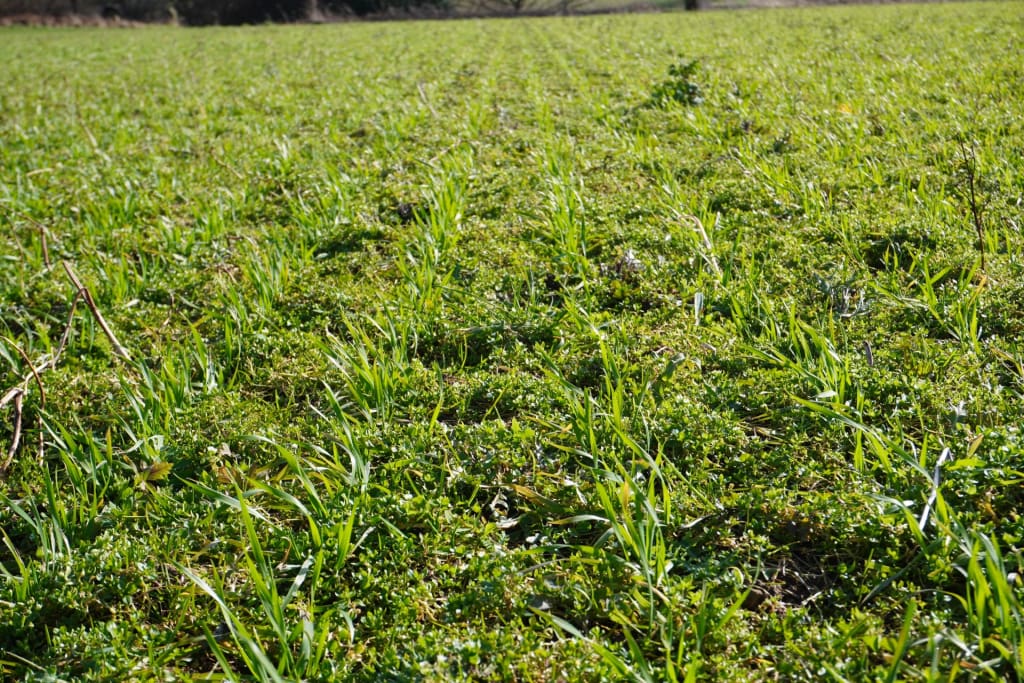
The ‘Living Mulch System’ is whereby a perennial legume understorey is established as a living ground cover under an arable crop and kept in situ for multiple years without the need for re-seeding. Cash crops are directly drilled into that understorey each year. Success will allow regenerative farmers to reduce fertiliser and herbicide use, lengthen their rotation due to the weed suppressive effects of the understorey, and enhance soil health, carbon sequestration, and water infiltration due to a constant living root, and enhanced soil structure due to a reduced requirement for tillage.
Living mulch farming system trials screening different legume species and establishment practices at Denby Hall Farm summarised in this news item: Living Mulches in a no-till organic system: Lessons from the field and below:
Hannah and Alex Fraser, at Denby Hall Farm, aimed to address some of these challenges by screening different legume species, varieties and mixtures as well as establishment techniques, with the objective to maximise environmental benefits while reducing costs associated with yield penalty. The Living Mulch Farming System trial included 6 treatments, involving different white clover varieties, and combinations of white clover and other species (Persian clover, black medic and bird’s-foot trefoil) with winter wheat (Maris Widgeon) as the cash crop. The results presented here focus on the first year of the living mulch.
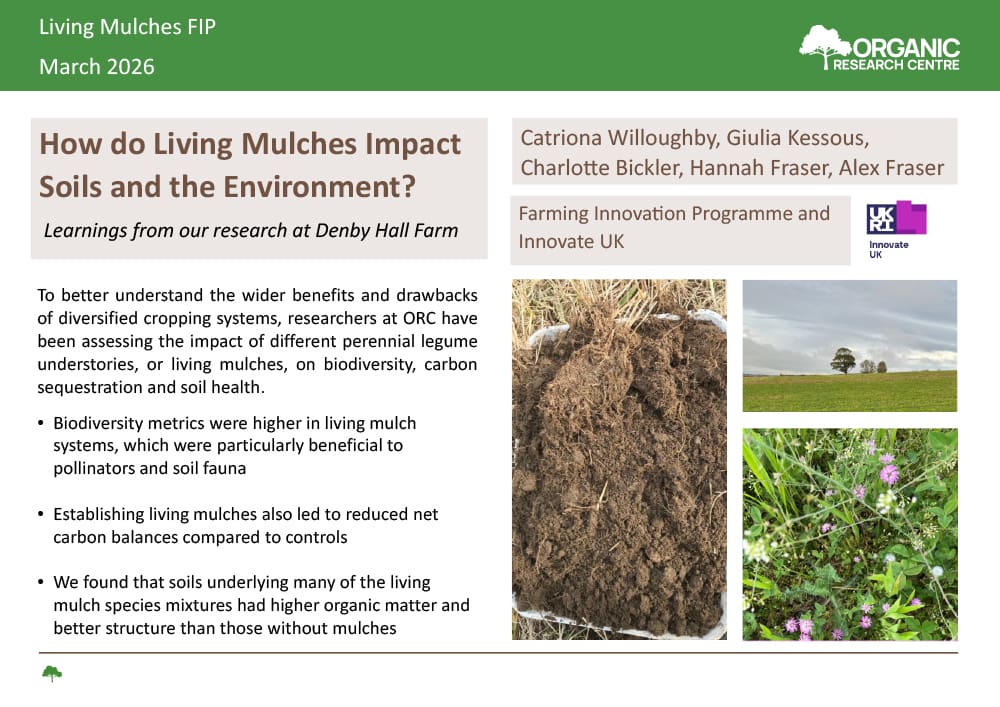
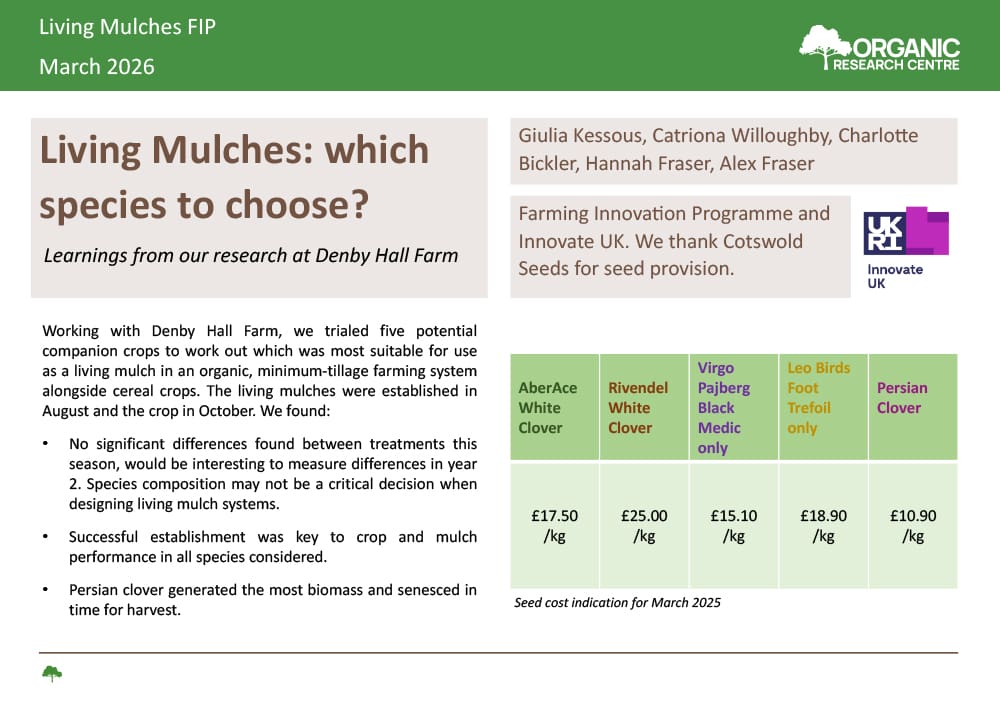
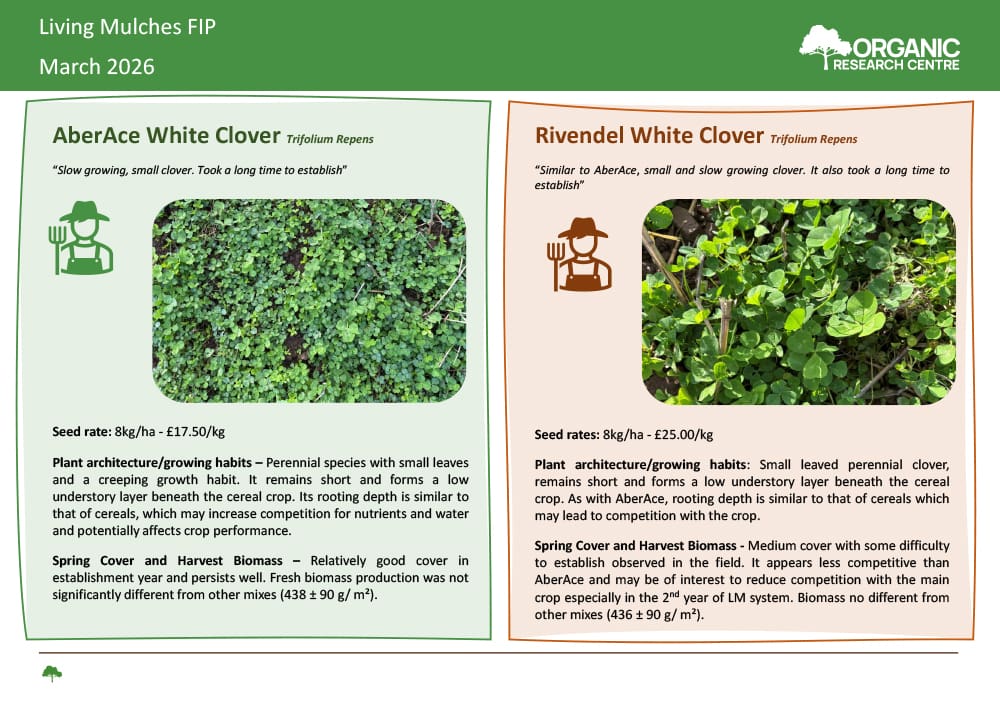
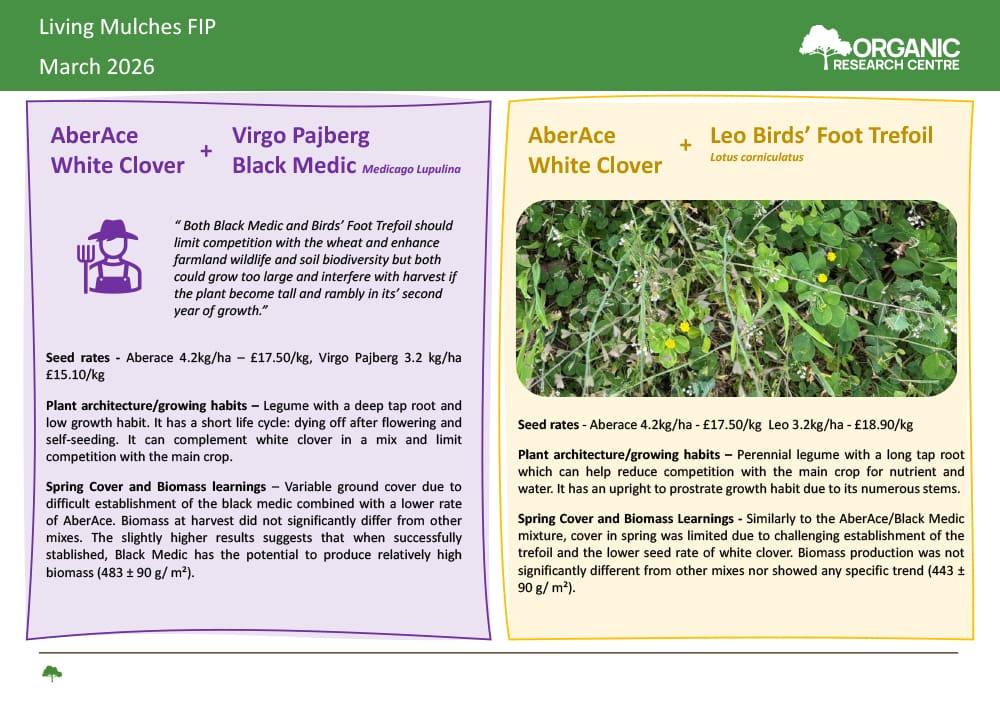
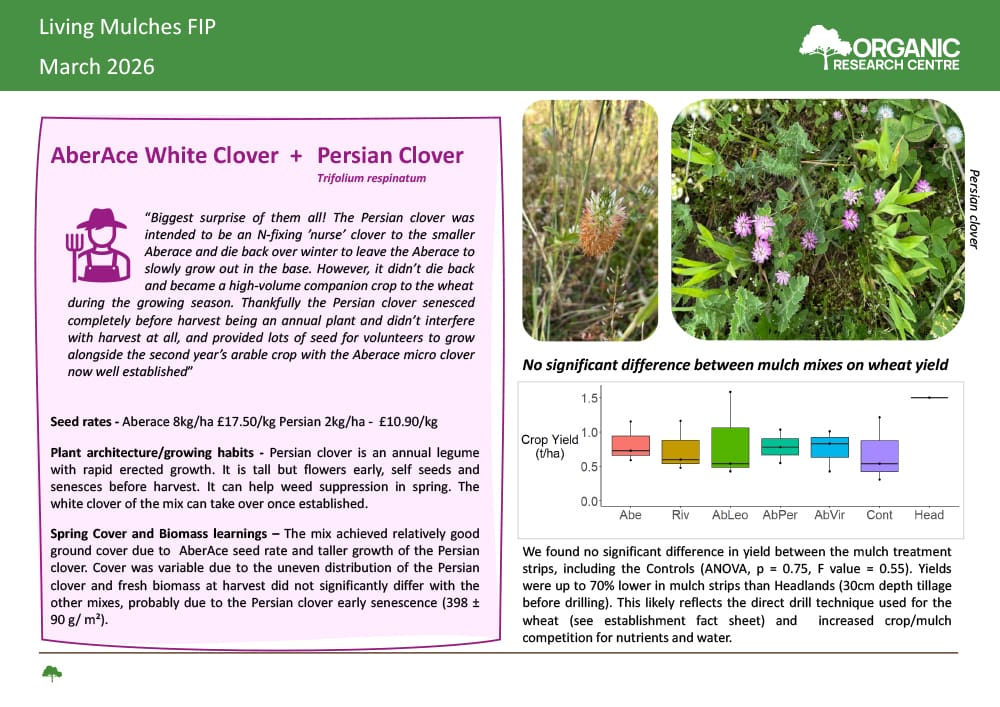
You can read more about our trial results in our factsheets:
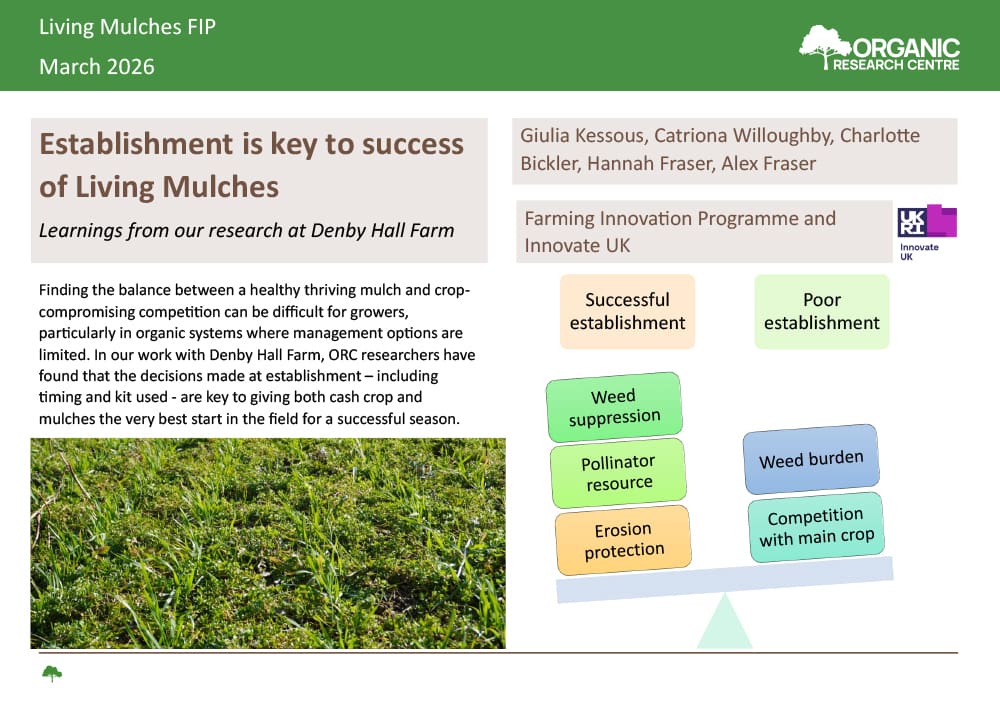
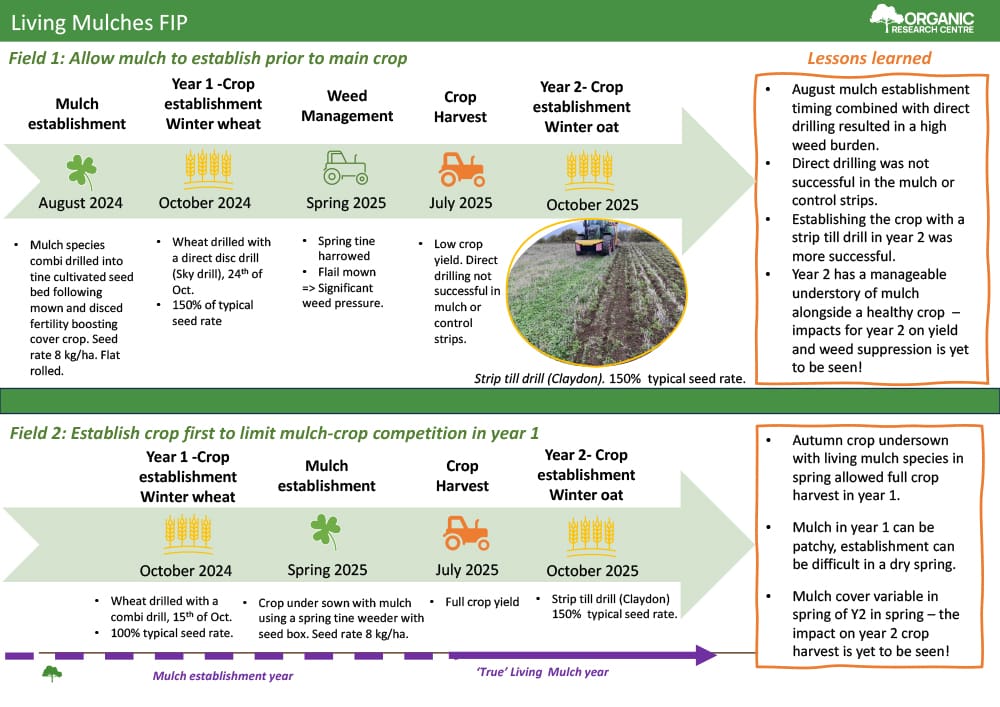
The timing of establishment and the choice of equipment kit are key to the overall success of a living mulch system. In our trial, the high weed burden during the establishment year was likely due to the summer establishment of the mulch, combined with reduced tillage practices. Slightly higher weed pressure was observed in the control strip, suggesting that the presence of the mulch may help suppress weed growth. Single-species white clover variety AberAce had the most consistently high results.
This context affected the crop performance. Early weed pressure and mulch-crop competition for light, nutrients and water contributed to lower yields in the first year, with reductions of up to 70% compared with a ‘control’ comparison strip at the edge of the field (normal tillage intensity, no mulch).
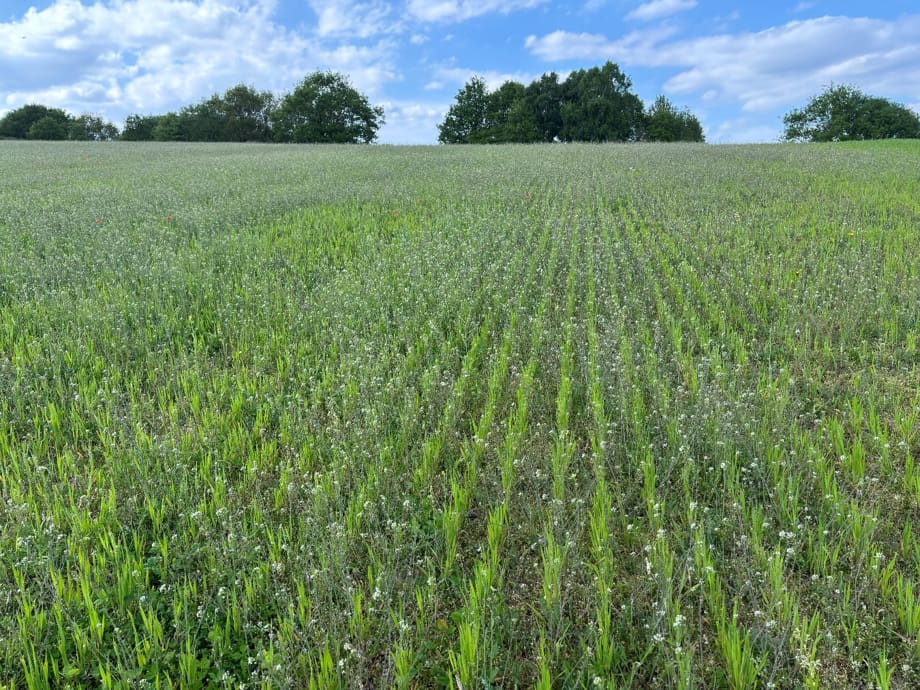
Alex Fraser gives his view on the second year of the process:
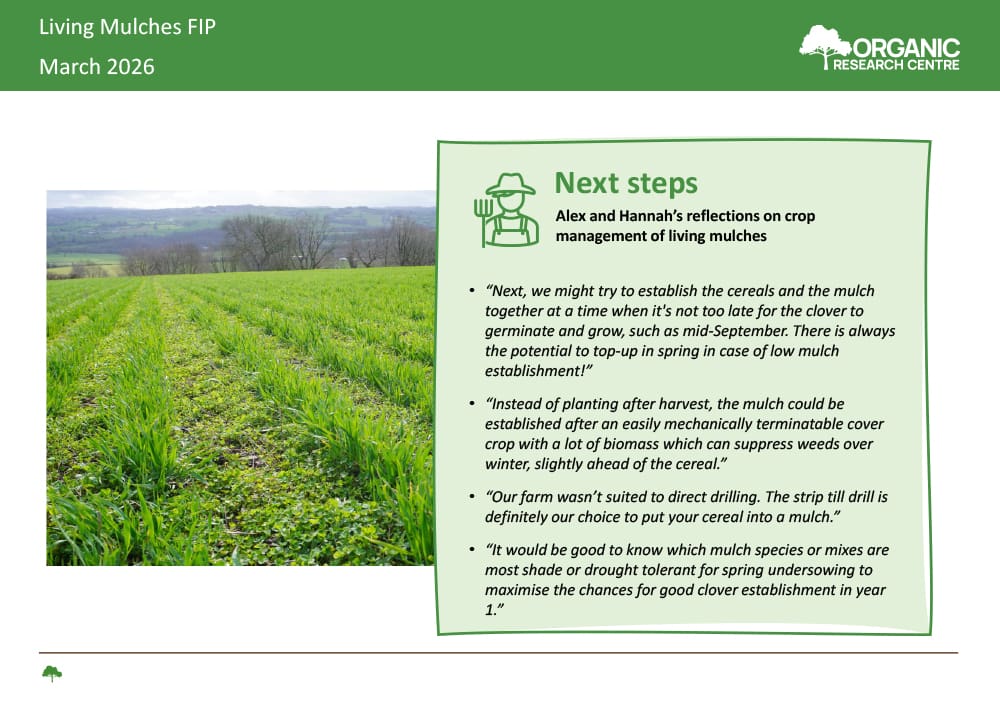
“Our experience for the second year was really positive, the mulch was well established throughout the field and as it was so dry it didn’t compete with the arable crop and stayed out of the way until harvest allowing combining to happen with ease. We even managed to bale the straw.
The oats did well, and were a lot more competitive than the wheat, which I put down to their different growth habit but also the Claydon drilling system which worked very well. Yield was about 1t/ac but this field hasn’t been down to grass for about 6 years so has a very low residual fertility now and with the dry weather I think this probably wasn’t too bad!”
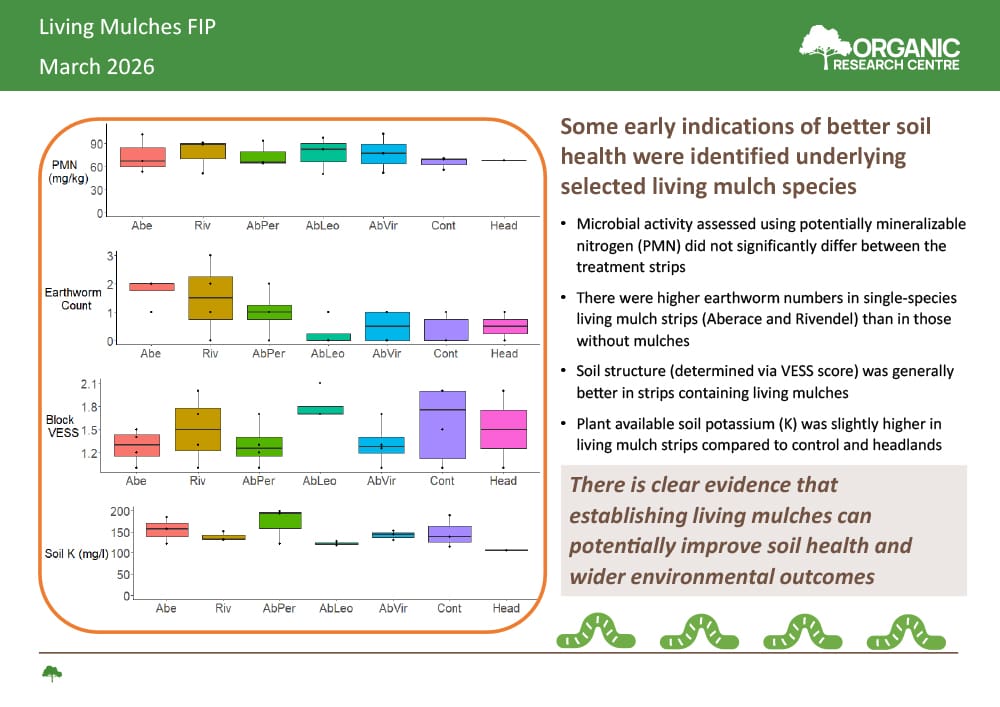
A key finding was that mixtures of mulch species did not perform significantly better than single-species mulches in weed management or regarding the competition with the cash crops, thus potentially simplifying management decisions around mulch establishment. But we found that mixtures had higher positive biodiversity scores, and we found early improvements in soil organic matter, earthworm abundance and soil structure for some mulch species.
Alex says “I don’t think there was much difference between varieties in the living mulch strips in Year Two either, but from the few plants I saw of Lotus Corniculatus, these would be problematic at a high inclusion. I think sticking to the small white clovers and black medic (Medicago Lupulina) would be a good option.”
We found some early indications of better soil health for some of the living mulch species. The soil structure was generally better in the strips containing living mulches and there were higher earthworm numbers in the white clover single-species strips.
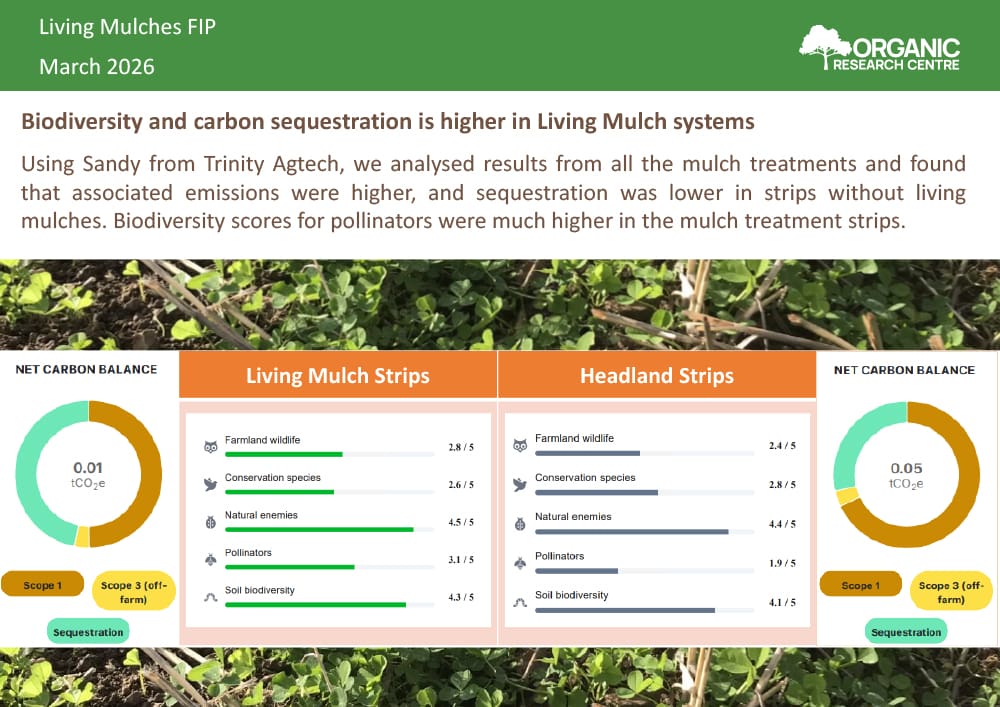
We also used the Sandy Tool from Trinity Agtech to model the public good benefits of the living mulch system. The results indicated lower emissions intensities in living mulch stips than the control and headlands, almost half in some cases! It was primarily due to higher estimation of C sequestration rather than differences in fuel usage or residue management. Mulch treatment strips had also the lowest modelled N leaching rates compared to the headlands. Biodiversity results showed the potential for living mulches to encourage greater pollinator numbers. With mixtures achieving highest overall positive biodiversity scores compared with single-species treatments.
We highly recommend that future work prioritises multi‑year replicated trials, more thorough investigation into the associated below‑ground processes, and a clearer understanding of how species choice and management can balance competition with the crop while maximising soil health and environmental and nutritional advantages.
The Organic Research Centre is currently working on a new ADOPT project, screening new potential mulch species including herbs and different sowing systems.
We held a joint event with Agricology and OPER8 Beyond the label: Exploring resilient & regenerative organic agriculture on June 2nd, hosted by Hannah and Alex Fraser, which highlighted the farm’s work with living mulches and agroforestry. Read Giulia’s blog here.

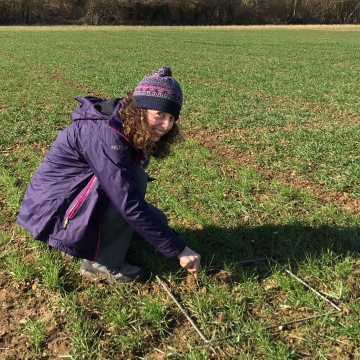
We have been observing the trial establishment and planning field assessments for the coming spring/summer season. We are also working with Agricology and have conducted an interview for a farmer profile on their website, as well as filming an update on trial establishment – coming soon.

The No-till and Living Mulches Field Lab with Innovative Farmers. For more information see: Living Mulches: Final Report 2020-2022
ORC Living Mulches built on this work.
See: How to get started with living mulches
Leading the project